Commercial Roof Maintenance
in San Jose
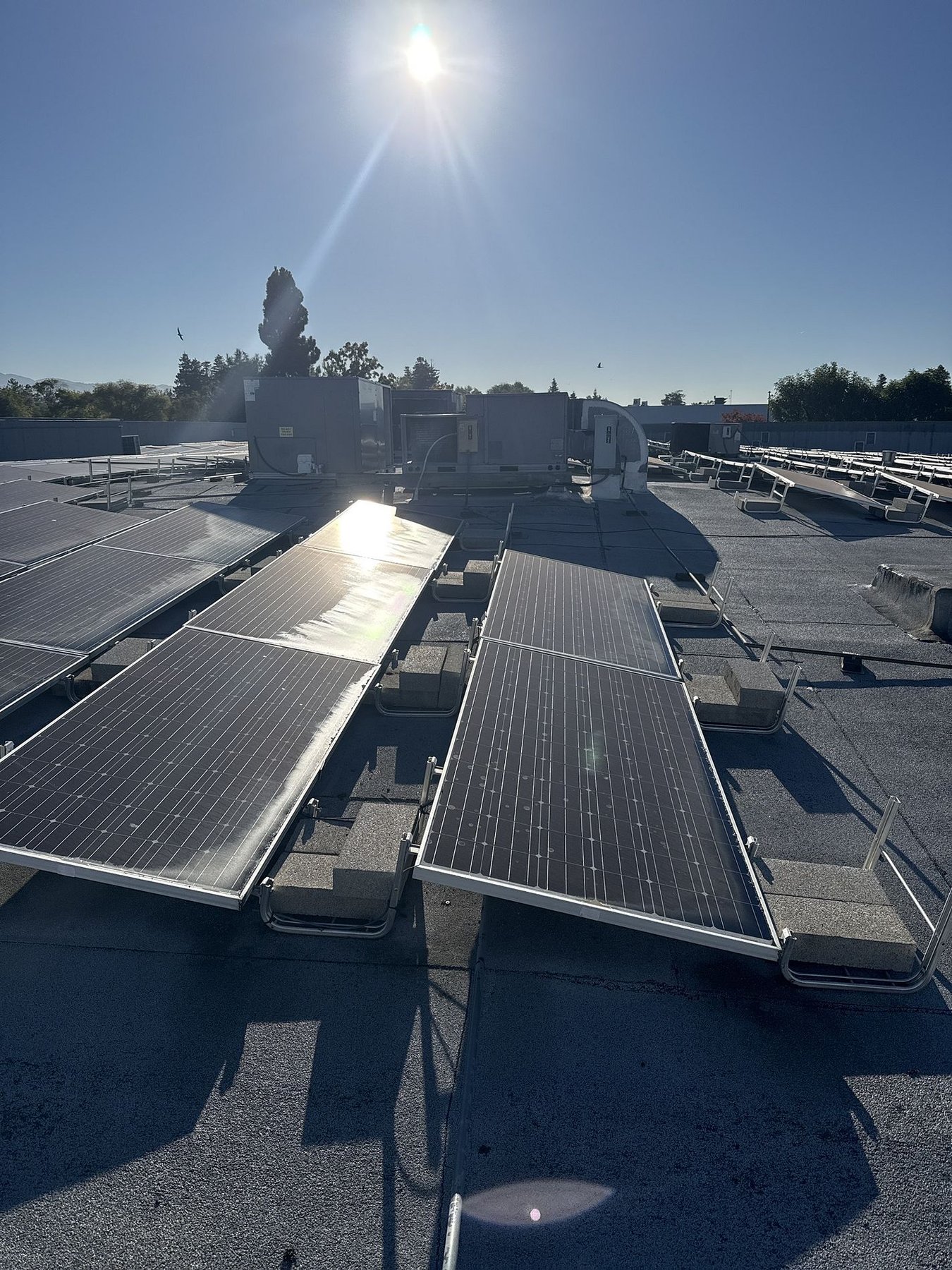
A full-building commercial roof maintenance project on a San Jose commercial property with extensive rooftop solar — detailed inspection, problem-area identification, penetration and flashing sealing across the entire roof, and fresh protective coating at all flashings. Working around an extensive ballasted solar array required extra precision and care, but the final result came out excellent. Another roof protected and performing at its best.
What the Homeowner
Was Dealing With
The property owner brought us in for a scheduled commercial roof maintenance cycle on a San Jose building with an extensive rooftop solar installation. The roof is a modified-bitumen / built-up assembly with granulated cap sheet — a common commercial flat-roof system for Silicon Valley office and light-industrial inventory. The challenge wasn't structural; the roof was in serviceable condition. What it needed was the kind of careful attention that keeps commercial flat roofs performing at 25-40 year service lives instead of failing at 15-20: every penetration sealed, every flashing renewed, every problem area identified and addressed before it becomes a leak.
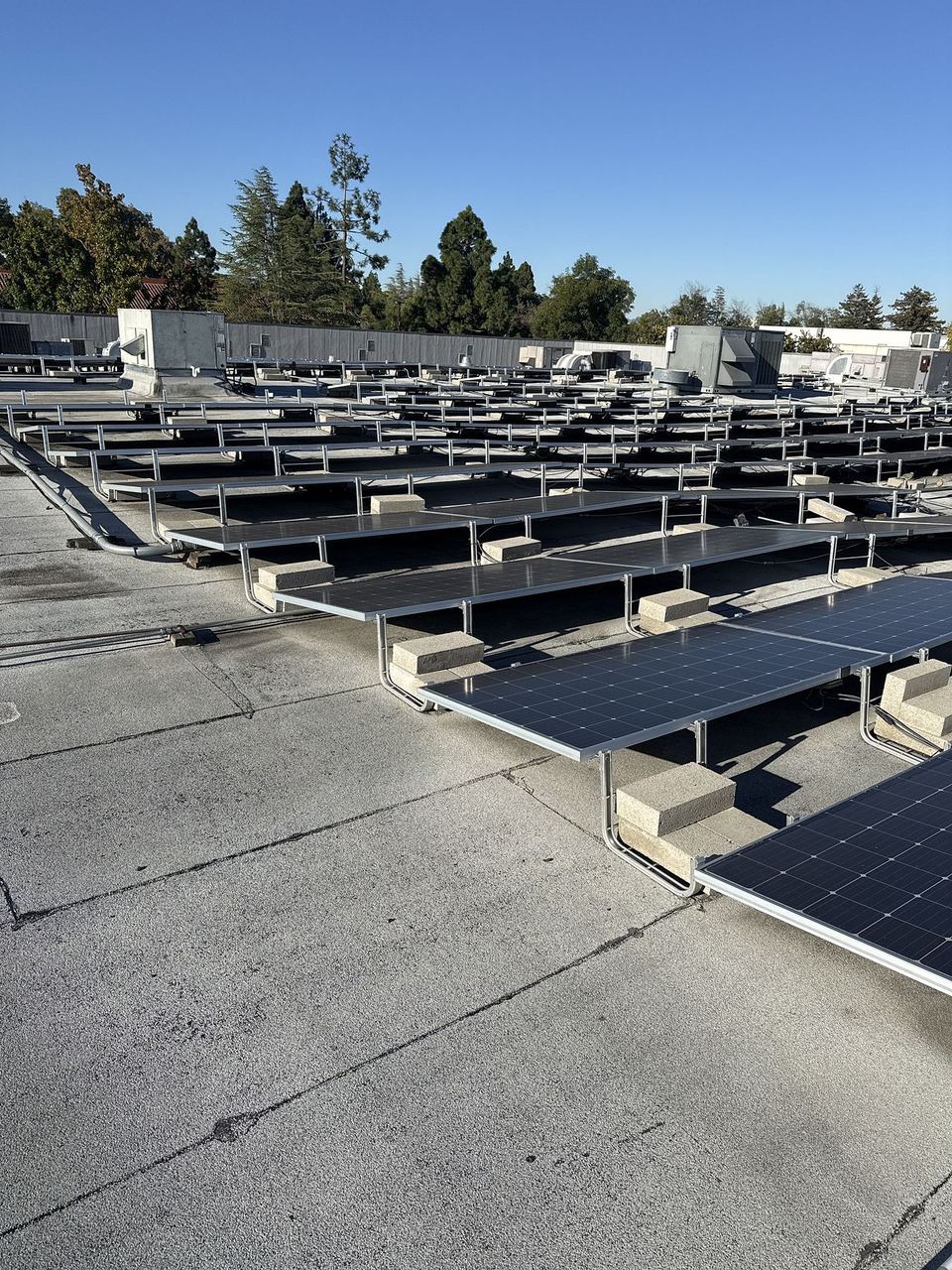
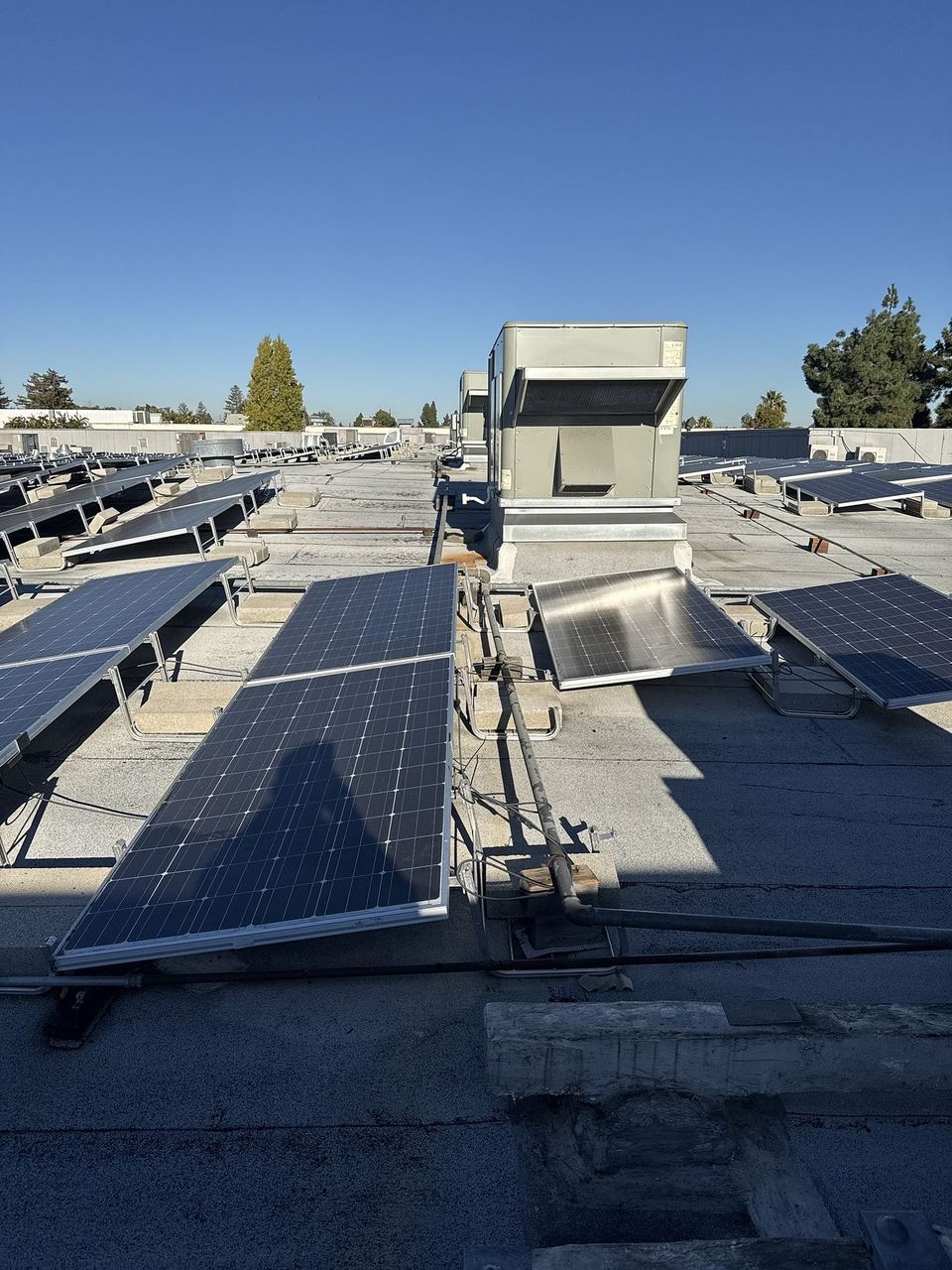
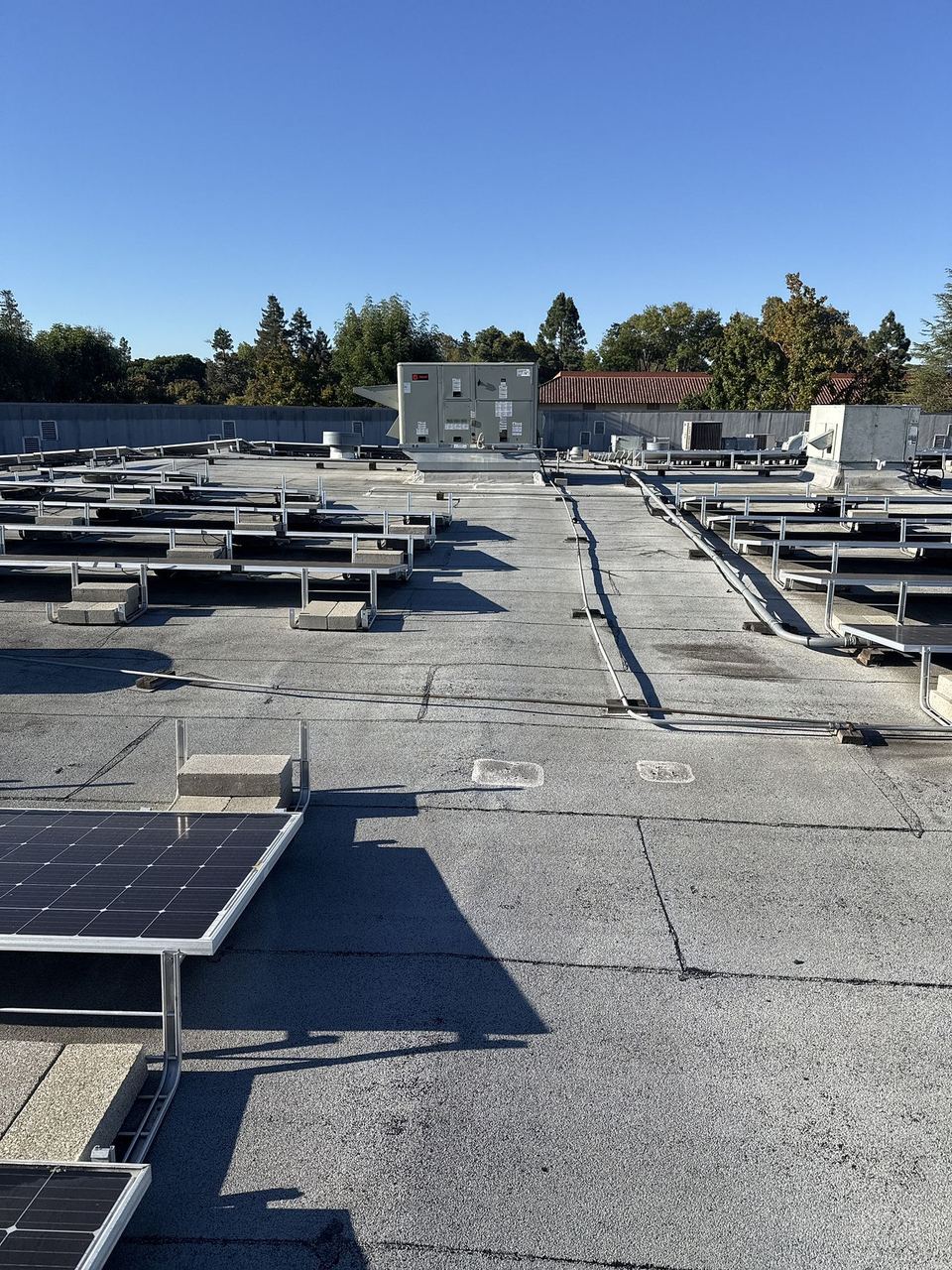
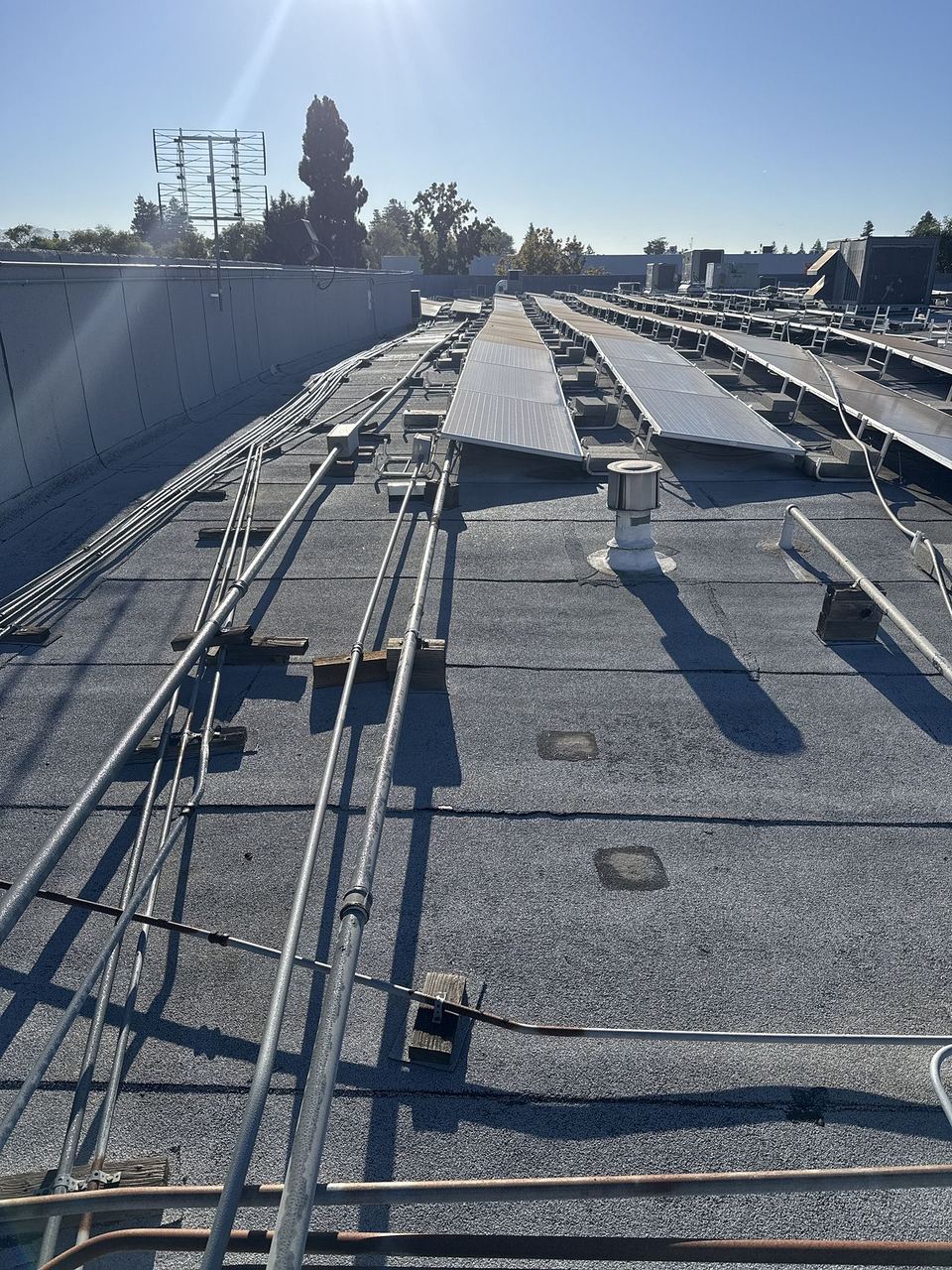
The complication was the solar array. The roof carries extensive ballasted solar panels — multiple rows across most of the roof surface, with concrete block ballast supports, interconnected racking, conduit runs between arrays, and attachment-point transitions. Working around an active solar installation requires methodical coordination — panels can't be moved without involving the solar contractor, ballast supports sit directly on the roof membrane, and any cutting or heat-based work has to be performed at a safe distance from electrical equipment. We work with solar coordination routinely, and on this project we kept all flashing and coating work to areas accessible without disturbing the solar system.
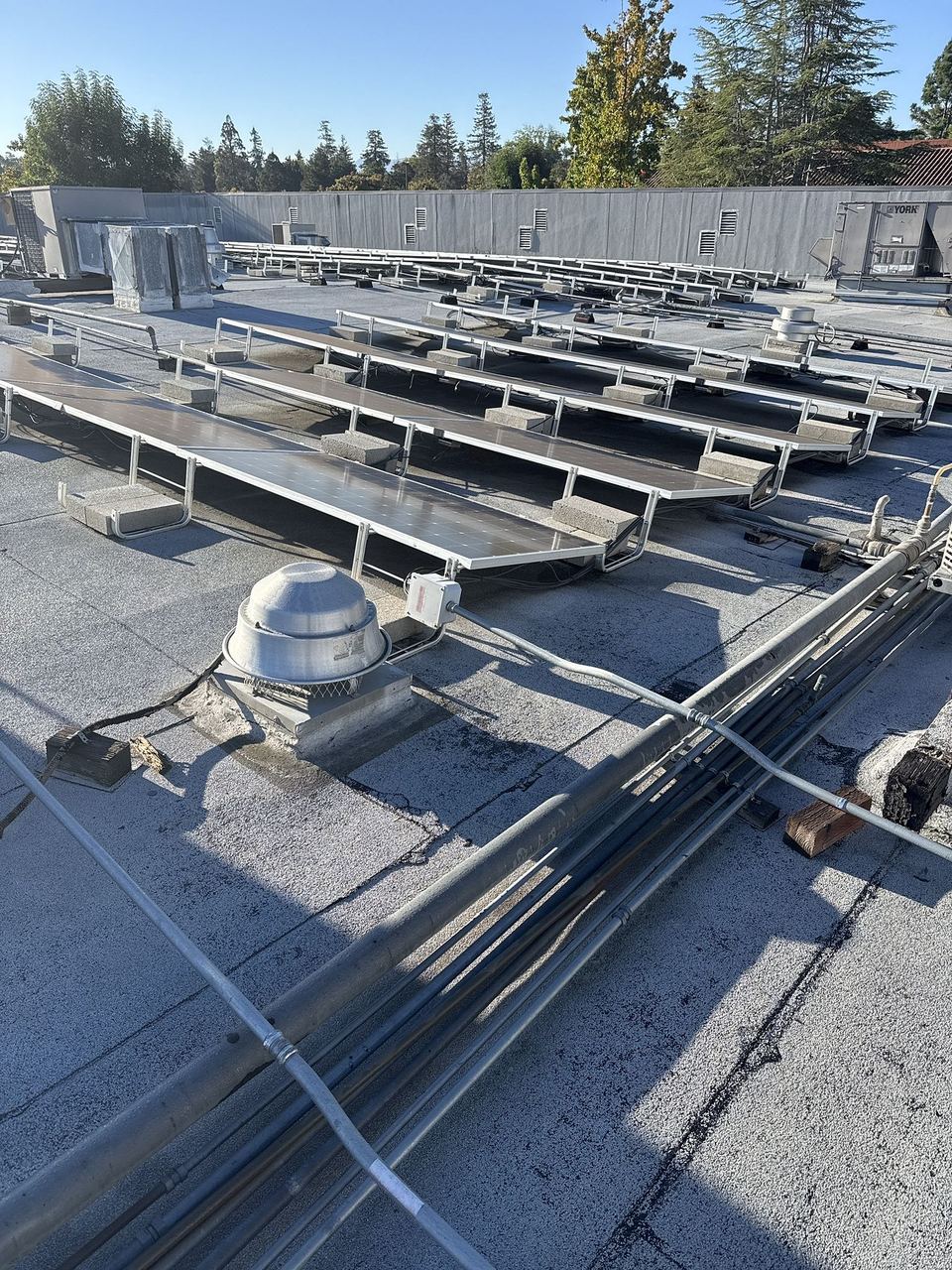
Additional scope items: multiple YORK-branded HVAC units with flashing that needed renewal at their curb intersections, several dome vents and louver penetrations through the parapet wall assemblies, and extensive conduit runs crossing the roof on pipe supports. Commercial roofs accumulate penetrations over time as tenants add equipment, and each penetration is a potential leak point that has to be maintained during any serious maintenance cycle.
How We Diagnosed & Planned the Work
Our approach on commercial maintenance work is systematic inspection before any repair decisions. We start with a full-roof walk-through, documenting every penetration, flashing termination, drain condition, seam state, and area of visible wear. Digital photos tied to a roof plan create a documented baseline that's useful for the property owner's building records and for scheduling the next maintenance cycle.
From the inspection, we identify priority areas — typically the penetrations showing the earliest signs of sealant failure, flashings with cracking or lifting edges, drains with compromised flashing collars, and seams showing minor separation. The principle is proactive vs. reactive: a $150 tube of sealant applied at the right flashing today prevents a $15,000 tenant-space water damage claim three years from now. Commercial property managers who understand this math are the property managers who keep their roofs at 30+ years of service life.
For this project specifically, the work covered all rooftop penetrations (HVAC curbs, dome vents, louvers, conduit supports, drains), all flashings at parapet walls and internal transitions, and comprehensive protective coating application at flashing terminations. The protective coating — a high-quality elastomeric or aluminum-pigmented roof coating, selected based on the existing membrane compatibility — provides an additional waterproof layer at the most failure-prone areas and a reflective UV barrier that extends the underlying flashing's service life significantly.
Step by Step —
What We Did
Full-Roof Inspection & Problem Area Documentation
Complete walk-through of the entire roof surface with systematic documentation of every penetration, flashing, drain, and area of visible wear. Digital photos tied to a roof plan create a maintenance baseline. The solar array perimeter was mapped to identify accessible work areas vs. restricted zones requiring solar contractor coordination.
Penetration Sealing — HVAC Curbs, Vents, Conduits
All rooftop penetrations inspected and resealed. YORK HVAC unit curbs re-flashed at intersections with the roof membrane. Dome vents resealed at their collars. Pipe supports and conduit penetrations addressed where wood blocks and mounts create localized wear on the membrane below. Any compromised sealant cleared and replaced.
Flashing Work at Parapet Walls & Louvers
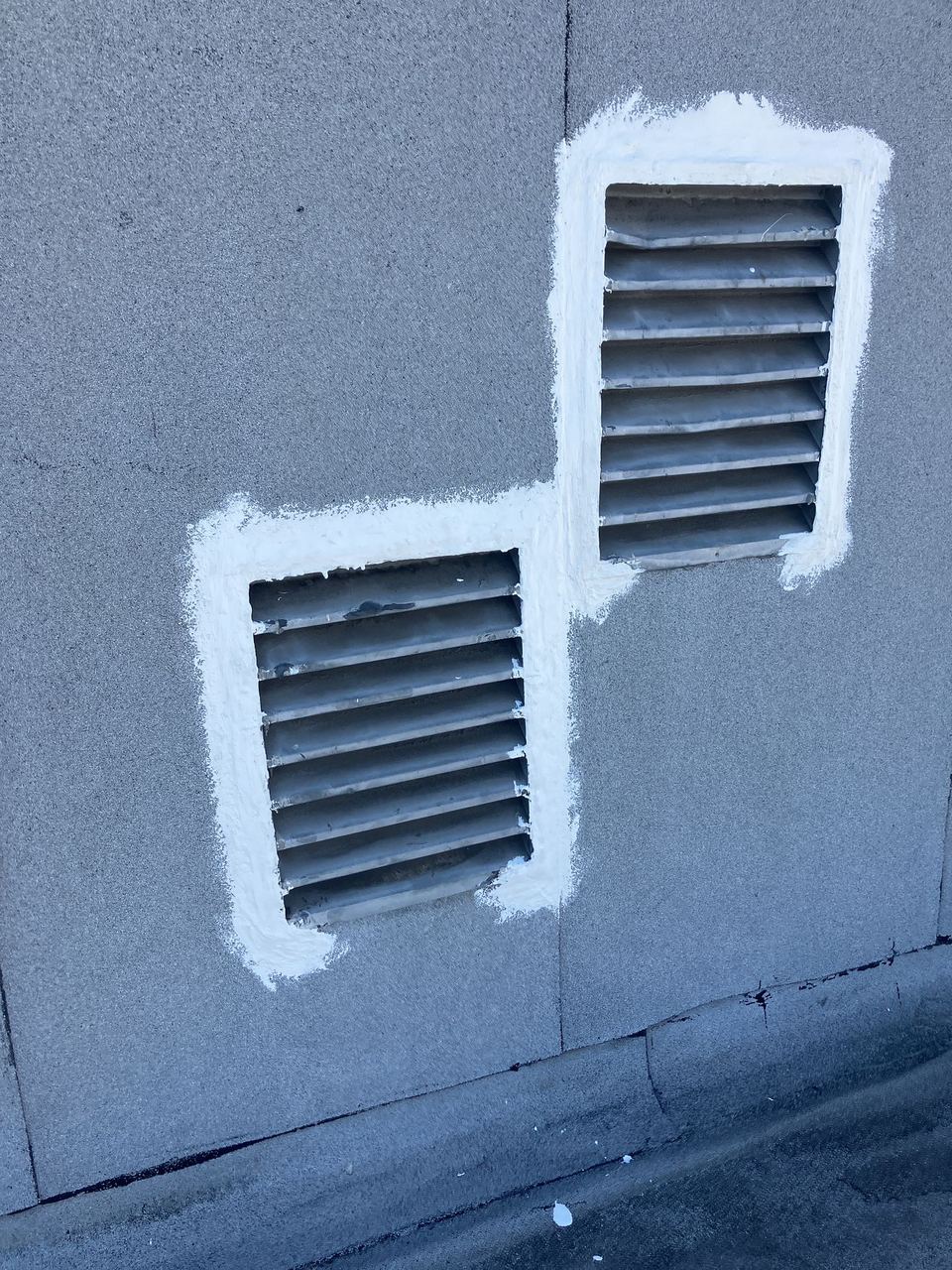
All parapet-wall flashings inspected for cracking, lifting, or sealant failure. Louver vents in parapet walls resealed with fresh flashing compound visible as the white coating in the workmanship photos. Counter-flashing terminations re-secured at all wall transitions.
Drain & Scupper Flashing Renewal
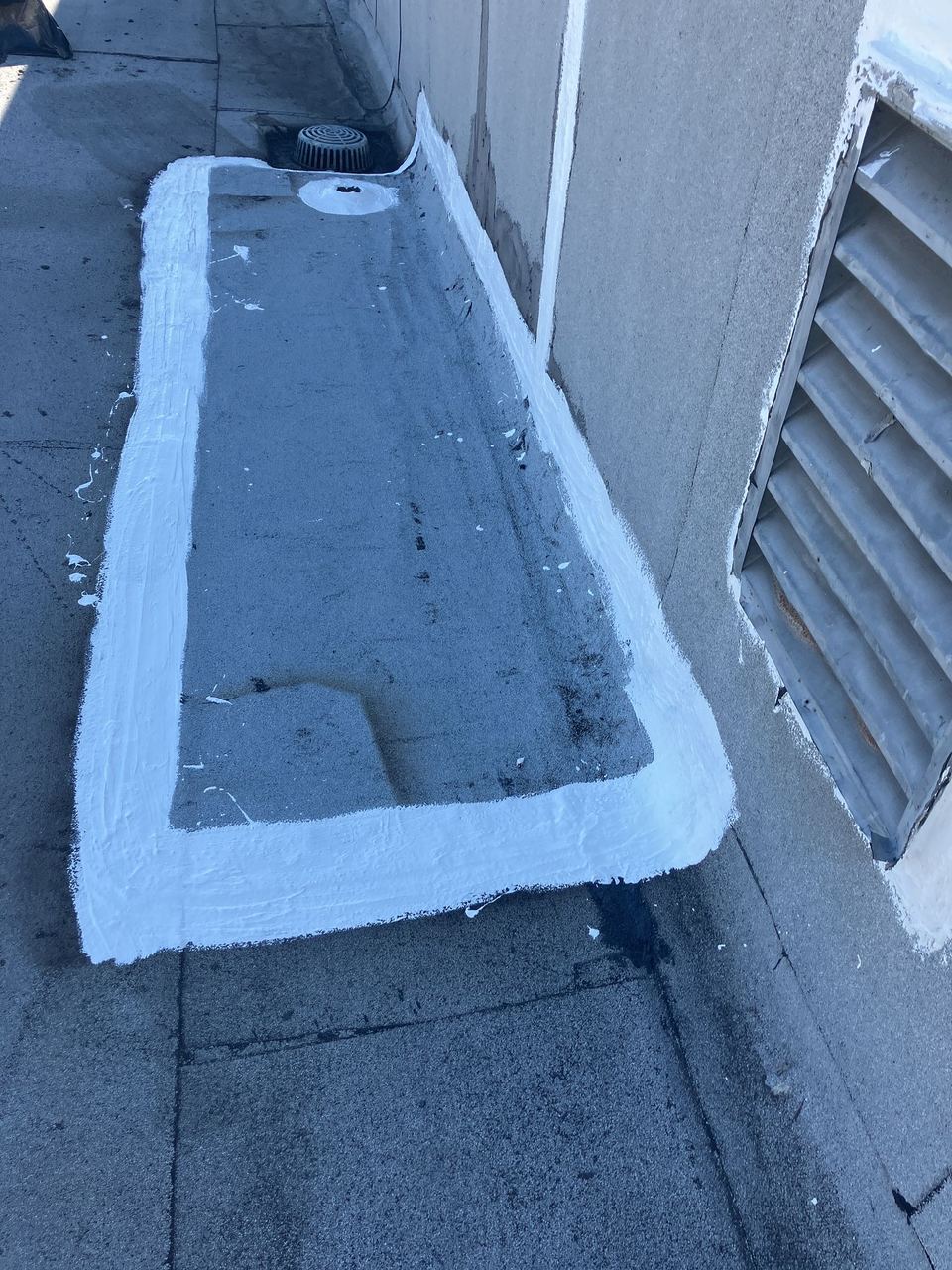
Roof drains and any scuppers inspected. Drain flashing pans cleaned and recoated with protective sealant as visible in the drain workmanship photo. Compromised drain flashing collars addressed. Drains flushed to verify flow before project closeout.
Seam Inspection & Spot Reinforcement
Roof membrane seams walked and inspected for minor separation or granule loss. Spot reinforcement applied where seams showed early-stage wear — more cost-effective than waiting for seam failure to trigger a larger repair.
Protective Coating Application at All Flashings
High-quality protective coating applied at all flashing terminations, penetration perimeters, and high-wear areas. The coating provides a supplementary waterproof barrier, UV resistance, and a clean visual finish. Visible in the workmanship photos as the bright white finish around drains, louvers, and flashing edges.
Final Walk-Through & Documentation Handover
Final walk-through with the property owner or manager. Complete photo documentation of before/during/after stages handed over for building records and future maintenance reference. Scope-of-work report detailing every area addressed.
Premium Materials
on This Project
Elastomeric Flashing Sealant
Commercial-grade elastomeric sealant applied at all penetration perimeters, curb intersections, and flashing transitions. Maintains flexibility through thermal cycling better than standard asphalt sealants — important on commercial roofs that can see 100°F+ surface-temperature swings between summer afternoon and winter night.
Aluminum-Pigmented Roof Coating
Reflective protective coating applied at flashing terminations and high-wear areas. The aluminum pigmentation provides significant UV protection for the underlying sealants and flashing substrate, meaningfully extending their service life. Visible as the bright finish in the workmanship photos.
Butyl Rubber Caulk
Used at specific locations where extra long-term flexibility is needed — particularly at conduit mount base connections and around equipment curbs. Butyl rubber has extremely long service life and maintains seal integrity across thermal cycles.
Polyester Reinforcement Fabric
Used at flashing transitions and around repaired areas. The polyester fabric is embedded in the sealant/coating to provide mechanical reinforcement and crack resistance, significantly extending the service life of the flashing repair.
Modified Bitumen Patching Compound
For spot repairs to seams or minor roof-surface wear. Compatible with the existing modified bitumen membrane system for proper adhesion and long-term bond.
Stainless Steel Termination Hardware
Corrosion-resistant fasteners for any new counter-flashing or termination bar work. No galvanized hardware that would corrode before the flashing system needs replacement.
What the Client Got
The final result came out excellent. Every penetration on the roof is now properly sealed, every flashing has a protective coating layer, and the property owner received complete photo documentation of the work for building records and future maintenance reference. The solar array was not disturbed — all work was performed in accessible perimeter areas and between array rows, with no solar contractor coordination required.
More importantly, the roof is now set up to perform. Commercial flat roofs fail at penetrations and flashings before they fail in the field — and every one of those priority areas has been addressed. The property owner has documented proof of proactive maintenance, which supports insurance coverage, tenant SLA commitments, and the long-term building-value case. Another roof protected and performing at its best — and a good example of the kind of systematic commercial maintenance work we do across Silicon Valley every year.
Commercial Roof Maintenance
Photo Archive
Why This Matters
in San Jose
Silicon Valley has one of the highest concentrations of commercial flat-roof inventory in the United States — the office campuses, light-industrial buildings, R&D facilities, and multi-tenant commercial properties that house the tech economy all sit under flat modified-bitumen, single-ply, or built-up roof assemblies. San Jose alone has tens of millions of square feet of commercial flat roof, and much of that inventory is at or past its first major maintenance cycle.
What's specific to commercial roofing in San Jose right now: solar retrofit density is extremely high. California's solar mandates for commercial buildings, combined with long-term energy economics, have driven very widespread solar installation across Silicon Valley's commercial inventory. A meaningful share of San Jose commercial buildings now have rooftop solar — which means any maintenance or repair project has to work around active solar equipment. We handle solar coordination routinely on commercial work, and it's increasingly a baseline requirement rather than an edge case.
The economics of commercial roof maintenance also deserve attention here. A proactive maintenance cycle on a 30,000-50,000 sq ft commercial roof runs a small fraction of the cost of a full re-roof, and performed on a reasonable schedule (every 3-5 years for typical modified-bitumen systems), it can double the effective service life of the roof. The 50-60 year service lives that top-tier commercial roof systems can deliver are only achievable with this kind of systematic maintenance — a roof that never gets maintained typically fails at year 18-22 regardless of the original membrane quality. Silicon Valley commercial property owners who treat roofing as a maintainable asset rather than a disposable system get significantly better lifecycle economics, and the difference compounds across portfolios.
Frequently Asked
About This Type of Work
Similar Projects
Crown Blvd Commercial
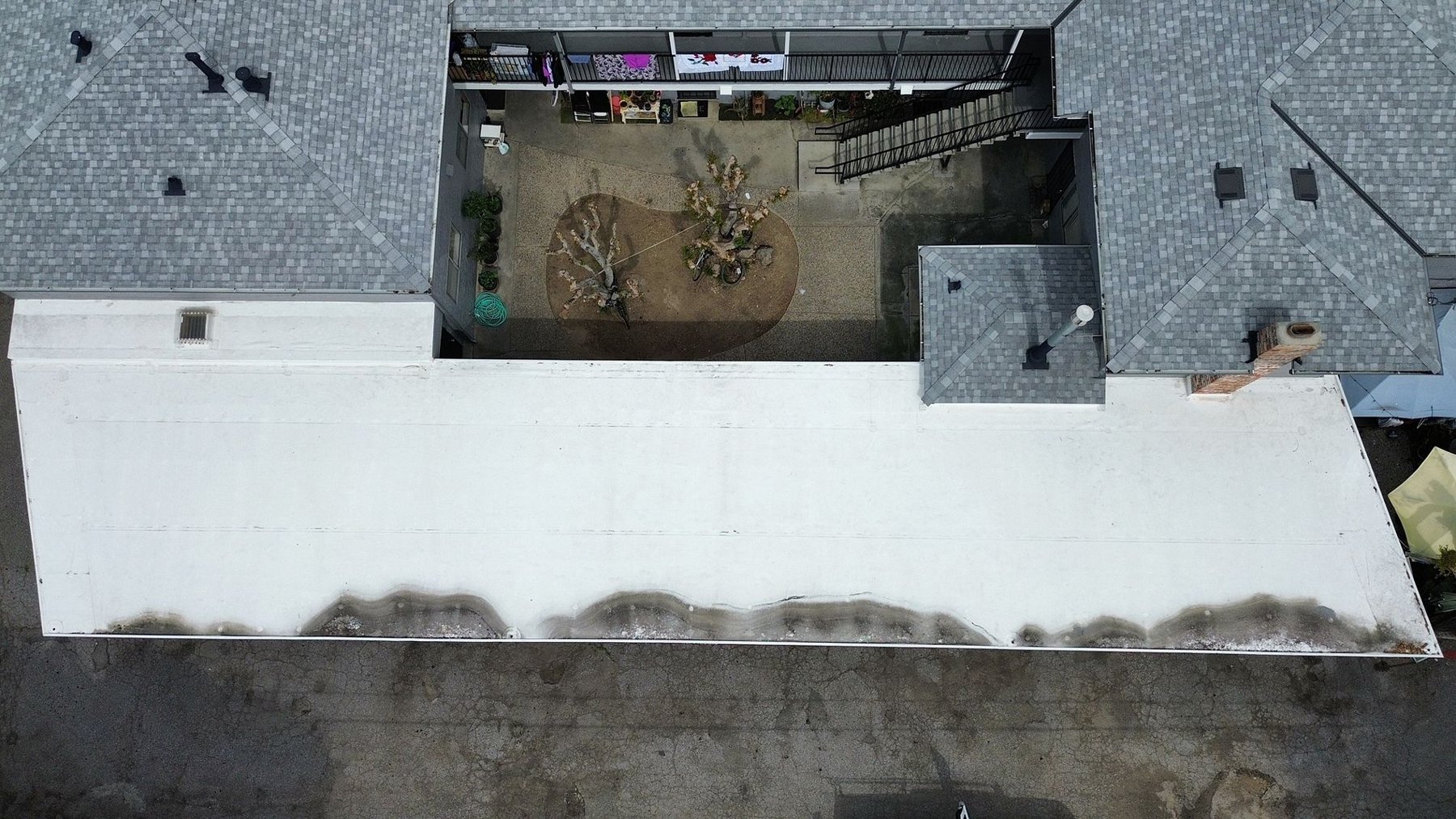
A 14,000 sq ft commercial flat-roof installation on Crown Boulevard — full tear-off, tapered insulation system, and single-ply membrane ...
Evergreen Tile Fire Damage Repair
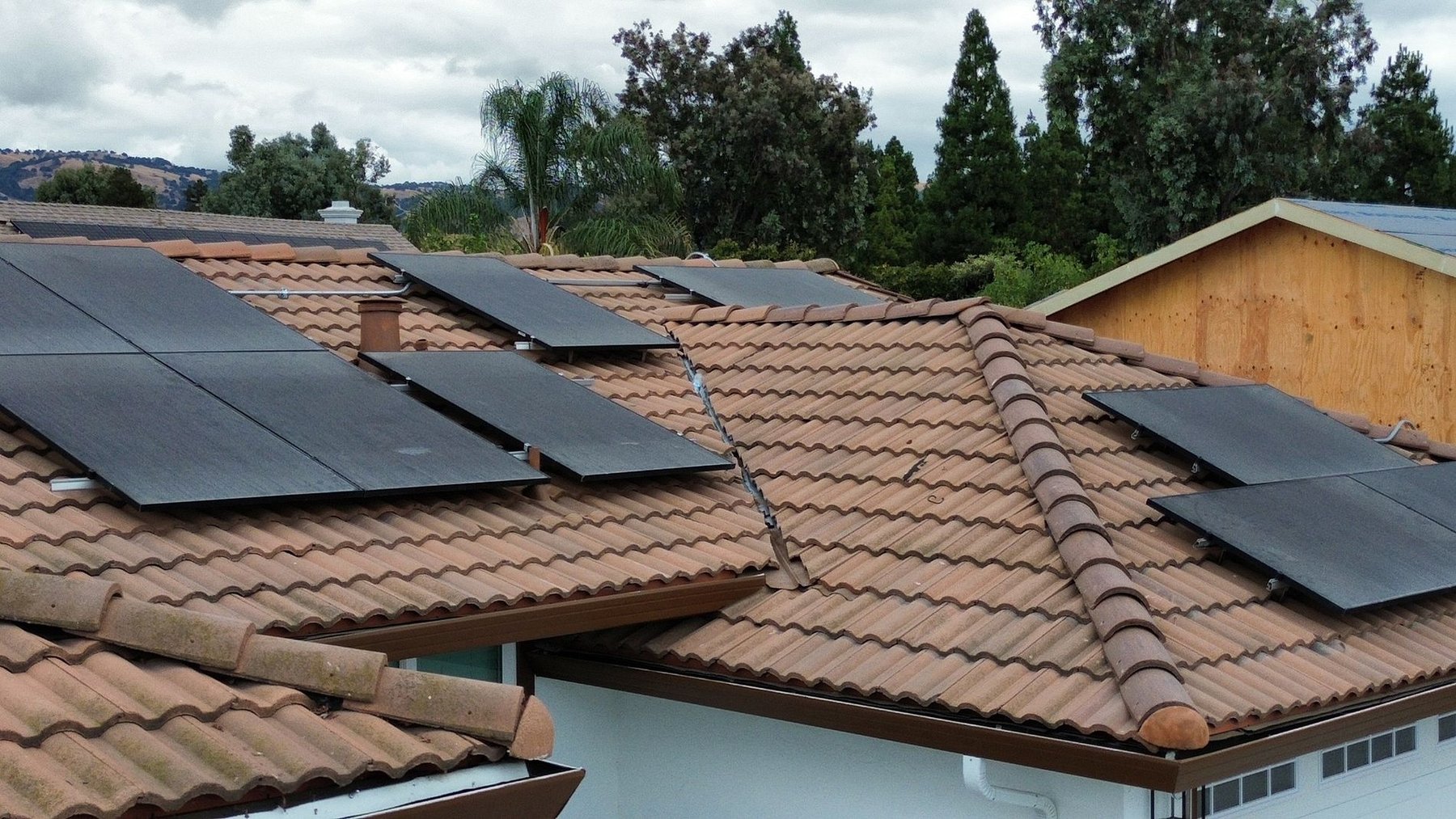
A specialty tile fire damage repair in San Jose's Evergreen neighborhood — detailed tie-in work matching the existing concrete tile for a se...