Wood Shingle Roofing
San Jose & the South Bay
Class A fire-treated Western Red Cedar shingle roofing for heritage homes, mid-century moderns, Craftsman bungalows, and custom architecture. State Fire Marshal listed treatment, installed per Chapter 7A WUI assembly requirements where your jurisdiction permits.
Cedar Shingle Roofing
Where Architecture Calls For It
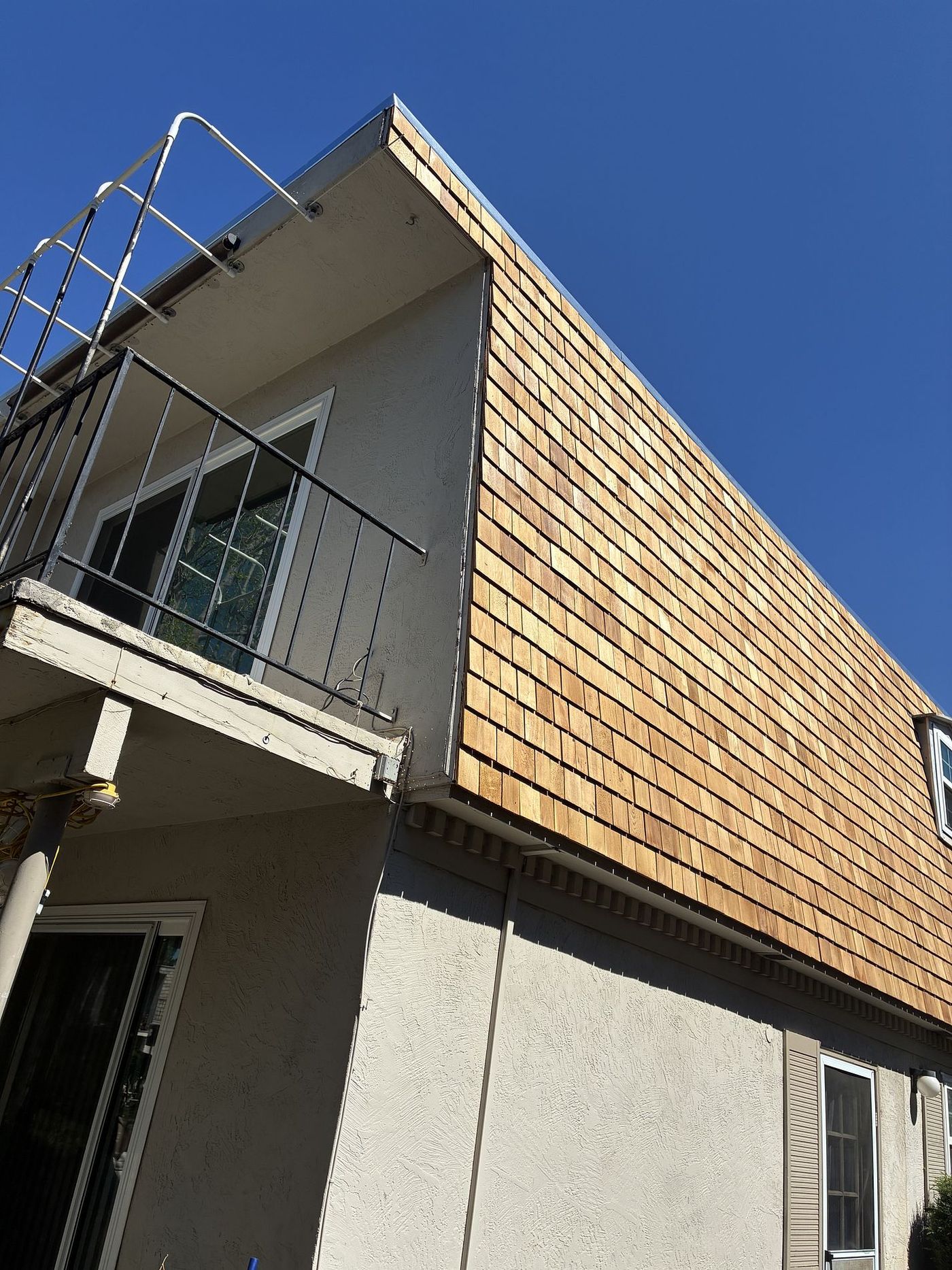
Cedar shingles look like nothing else. Warm natural wood tones when freshly installed, weathering to silver-grey over decades, dimensional texture that catches light differently than any other roofing material. Some homes are built specifically around that look — Sea Ranch-style architecture, mid-century moderns, Craftsman bungalows, heritage Victorians, and custom designs where the architect specified cedar as part of the building's identity. For those homes, no other roofing material is a substitute. Keith Roofing installs Class A fire-treated Western Red Cedar shingles for homeowners whose architecture calls for it and whose jurisdiction permits the install.
The honest framing: cedar is a regulated, premium-priced, architectural-fit product, not a default residential roof choice in 2026 California. Three things matter. Fire code reality — California Chapter 7A WUI code requires Class A roof assemblies in Fire Hazard Severity Zones, and some Bay Area jurisdictions further restrict wood shingles even with fire treatment. In the South Bay, this question matters most in the foothill-bordering jurisdictions: much of Saratoga and Los Gatos sits in Very High Fire Hazard Severity Zones, and some hillside parcels in those towns won't permit wood shingles regardless of treatment — these are exactly the heritage-architecture homes (Sea Ranch-style, custom mountain-contemporary) where cedar makes the most architectural sense, so it's worth checking the parcel's specific classification before getting attached to the material. We assess your specific parcel's classification before quoting and tell you upfront if code won't allow the install. Cost reality — Class A fire-treated Western Red Cedar runs roughly 2-3× the installed cost of composition shingle for the same roof area. A typical Bay Area residential roof that's $20,000-$30,000 in composition might be $50,000-$80,000 in treated cedar. The price difference pays for the architectural look. Service life reality — properly-installed Class A treated cedar delivers 20-30 years of service life with maintenance. Composition shingles deliver similar or longer service life at much lower cost. If the look isn't the priority, cedar isn't economically competitive.
Our cedar shingle work covers: new cedar roof installation on new construction or major renovation where the architecture calls for it; full reroof of existing cedar shingle roofs (cannot be overlaid — full tear-off is required); partial section reroof for mansard sections, dormers, or specific architectural roof sections in larger mixed-material projects; jurisdictional permissibility assessment before any project gets quoted (sometimes we tell homeowners their parcel is in a zone where wood shingles aren't permitted, regardless of treatment, and we recommend alternatives); and maintenance and repair on existing cedar roofs that still have service life remaining. Material: Class A fire-treated Western Red Cedar, No. 1 Grade (Blue Label), from State Fire Marshal listed treaters.
Understanding Cedar Shingle Roofing in 2026 California
The Regulatory Picture
California Chapter 7A of the California Building Code (CBC) sets the WUI (Wildland-Urban Interface) fire code requirements for roof assemblies in Fire Hazard Severity Zones (FHSZ). In those zones, Class A roof assemblies are required — the highest fire resistance rating defined by ASTM E108 / UL 790 testing. Class A fire-retardant-treated Western Red Cedar shingles and shakes are State Fire Marshal listed products from approved treaters, and when installed per the manufacturer's specified assembly (specific underlayments, deck preparation, ventilation requirements), they meet Class A assembly requirements.
The 2026 California WUI Code update tightened restrictions further. Some interpretations and local ordinances now prohibit wood shingles in WUI zones even with Class A treatment. The actual permissibility depends on your specific parcel — many Bay Area properties are outside designated FHSZ/WUI zones, where standard CBC roof covering rules apply and Class A treated cedar is permitted. Many other parcels are inside zones where wood shingles are now restricted regardless of treatment. We check your parcel before quoting, and we don't take projects we can't permit.
What Class A Fire-Treated Cedar Actually Is
Class A fire-treated cedar shingles are pressure-treated (not surface-coated) with a State Fire Marshal listed fire retardant chemical. The treatment is impregnated into the wood cells under pressure, so it doesn't wash out or wear off the surface. Surface coatings, stains, and paints are explicitly not approved methods of fire protection under Chapter 7A — we don't use those.
The treated shingles are sold by State Fire Marshal listed treaters (FSR Treatment, Inc. is the most established Bay Area source; White Mountain Building Products and others also list product). Each batch carries CSFM listing numbers and product documentation that goes into your project file for permit purposes. Treatment must pass ASTM D2898 accelerated weathering tests, which simulate UV and moisture exposure over the product's service life — meaning the fire resistance is intended to remain effective across the roof's 20-30 year service life.
Species, Grade, and Why It Matters
We install Western Red Cedar, No. 1 Grade (Blue Label in trade parlance) exclusively. No. 1 Grade is the premium tier — 100% heartwood (the rot-resistant inner wood, not sapwood), 100% edge grain (vertical grain orientation, which is the most stable and weather-resistant), and consistent dimension across the bundle. Lower grades (No. 2, No. 3) include flat-grain shingles and some sapwood inclusion, which weather faster and check more aggressively. The premium pricing of cedar roofs assumes premium-grade product — installing No. 2 or No. 3 cedar is a false economy that compromises service life.
Eastern White Cedar is a different species occasionally seen in California — we do not install it. White Cedar has shorter service life in California's climate (more moisture-related issues, less heartwood stability) and is not optimal for our conditions. Western Red Cedar from Pacific Northwest mills is the right species for Bay Area roofs.
Installation Specifics
Class A cedar shingle assemblies require specific underlayment and deck preparation per the manufacturer's State Fire Marshal listing. The deck typically requires solid sheathing (plywood or OSB), not skip sheathing — the open-spacing approach used in older cedar installs is generally not Class A compliant. The underlayment is typically a 72 lb. mineral-surfaced cap sheet (ASTM D3909) installed over the deck, which functions as a fire barrier between the shingle layer and any combustible deck below. The shingles install over the cap sheet with specified exposure (typically 5 inches for No. 1 Grade), with proper offset on each course and stainless-steel or hot-dipped galvanized fasteners. Valley flashings are 0.019" minimum corrosion-resistant metal over a continuous underlayment strip.
When Cedar Shingles
Are the Right Answer
Architecture Specifies Cedar
Sea Ranch-style, mid-century modern, Craftsman, heritage Victorian, custom homes designed around cedar. Replacing cedar with composition compromises the building's architectural identity.
Reroofing an Existing Cedar Roof
If your house already has cedar shingles and you want to maintain the look on reroof, treated cedar is the answer (where code permits). We assess code permissibility first.
Outside WUI/FHSZ Zones
Many Bay Area parcels are outside designated fire hazard zones, where standard CBC roof covering rules apply and Class A treated cedar is straightforwardly permittable.
Mansard or Architectural Section
Cedar on a mansard section or specific architectural element of a larger mixed-material roof. Targeted scope that delivers the cedar look without the cost of an entire roof.
Budget Tolerates Premium Pricing
Cedar runs 2-3× composition shingle cost. If the architecture and the budget both align, cedar delivers. If only one does, it's probably not the right answer.
Long-Term Ownership Horizon
Cedar costs more upfront but the visual payoff compounds with weathering — silver-grey patina on a properly-installed cedar roof is part of the architectural intent. Best for owners holding the property long-term.
Cedar Shingle
Systems We Install
Class A FSR-Treated Western Red Cedar
Pressure-treated by FSR Treatment, Inc. — the most established Bay Area-serving State Fire Marshal listed treater. No. 1 Grade Western Red Cedar, all heartwood, edge-grain, CSFM listed assembly.
White Mountain Listed Treatment
Alternative State Fire Marshal listed treatment for Class A assemblies. Used where supply or pricing favors it over FSR. Same code-compliance outcome.
72 lb. Cap Sheet Underlayment
ASTM D3909 mineral-surfaced cap sheet over the deck as part of the Class A assembly listing. Fire barrier between shingles and combustible deck.
Stainless Steel Fasteners
Stainless or hot-dipped galvanized fasteners required for cedar — standard fasteners corrode in cedar's naturally tannic environment. Premium fasteners are non-negotiable for service life.
Corrosion-Resistant Valley Flashings
0.019" minimum corrosion-resistant metal flashings at valleys, sidewalls, and penetrations. Copper, lead-coated copper, or stainless preferred for premium cedar installs.
Solid Sheathing Deck
Plywood or OSB solid sheathing required for Class A assembly. Older skip-sheathing decks are generally not Class A compliant and need overlayment as part of the reroof.
How We Handle
Your Cedar Shingle Project
Jurisdictional Assessment
Before quoting, we check your specific parcel against the local jurisdiction's WUI/FHSZ mapping and any local ordinances restricting wood shingles. If your parcel can't be permitted for cedar, we tell you upfront and recommend alternatives.
Site Assessment & Quote
On-site evaluation of existing roof, deck, ventilation, flashing details, and architectural fit. Line-item quote covering tear-off, deck repair allowance, underlayment, treated cedar, flashings, and disposal.
Permits & Material Specification
Permit pull with cedar-specific assembly documentation included. CSFM listing numbers for the specific treated cedar product, manufacturer's installation instructions, and Class A assembly specification submitted with the permit application.
Tear-Off, Underlayment, Cedar Install
Full tear-off of existing roofing. Deck inspection and any required deck work — skip sheathing typically requires overlayment plywood for Class A compliance. 72 lb. cap sheet underlayment installed. Treated cedar shingles installed at specified exposure with stainless or HDG fasteners. Premium flashings throughout.
Closeout & Documentation
Photo documentation of pre- and post-install conditions, CSFM listing numbers for the cedar batch installed, fire assembly documentation, manufacturer warranty registration, and our workmanship warranty — packaged for your records and any future insurance documentation needs.
Why Homeowners Choose Us
for Cedar Shingle Roofs
Honest Jurisdictional Assessment
We check your parcel's code situation before quoting. If your jurisdiction won't permit cedar regardless of treatment, we tell you upfront and recommend alternatives. We don't quote projects we can't permit.
Class A Assembly Expertise
Cedar shingle assemblies have specific Class A compliance requirements — underlayment, deck preparation, fastener selection, ventilation. We've installed cedar across enough Bay Area projects to know the assembly cold and document it correctly for permits.
No. 1 Grade Material, Premium Flashings
Cedar roofs depend on material quality — No. 1 Grade Western Red Cedar, stainless or HDG fasteners, premium copper or stainless flashings. We don't cut corners on cedar projects because the corners always show eventually.
70+ Years on Bay Area Roofs
Keith Roofing has been working on Bay Area homes since 1952, including cedar roofs since cedar was a default Bay Area material in the mid-century. We know what cedar does in this climate and how to install it for the service life it's supposed to deliver.
Recent Cedar
Roof Installations