CertainTeed Solar Roofing
San Jose & the South Bay
All three of CertainTeed's solar products — SunStyle solar tiles, Solstice solar shingles, and Solstice solar panels — installed by a CertainTeed-certified Keith Roofing crew. The advantage: your whole roof and the solar on it are backed by one CertainTeed warranty.
Solstice Solar Shingles
Solar That Looks Like a Roof
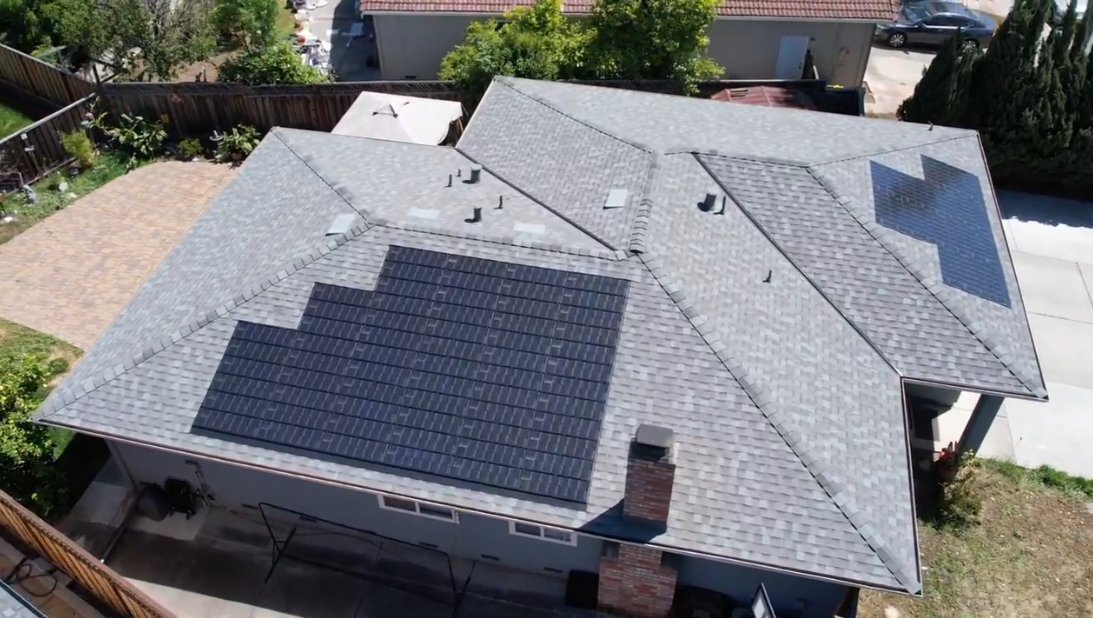
Solstice is CertainTeed's BIPV (building-integrated photovoltaic) solar shingle product — solar modules sized and shaped like architectural shingles, installed as part of the roof field instead of mounted on racks above it. The visual result is what you see in the photo: a roof with a flat, dark integrated solar section that reads as part of the roof rather than as hardware on top of it. No visible aluminum racking, no tilt frames, no rails, no exposed wiring — just a low-profile section of dark shingles producing electricity. Keith Roofing is a CertainTeed-certified installer for Solstice, which means we can register the integrated CertainTeed warranty that covers both the roofing and solar components together — a meaningful difference from traditional installs where panel and roof warranties live separately.
The honest pitch for Solstice is aesthetic, not economic. Traditional solar panels deliver more watts per dollar — Solstice runs roughly $4.50-$6.50 per watt installed, versus $3.00-$4.50 for conventional panel arrays. The cost premium pays for the integrated look, the absence of mounting hardware, and the single-warranty-for-both-systems story. Homeowners who choose Solstice typically care about curb appeal, live in HOA-managed neighborhoods where architectural committees push back on visible panels, are reroofing anyway and want to combine the projects, or have architectural styles where conventional racks would look wrong. If none of those apply and you just want maximum solar production for minimum dollars, CertainTeed's Solstice Solar Panels are the economical route — and we install those too, on a CertainTeed roof under the same single warranty. We'll talk through which of the three products fits your home honestly during the estimate.
Our Solstice work integrates with the reroof rather than treating it as a separate project. Tear-off and underlayment happen across the whole roof area as standard reroof work. Composition shingle install covers the non-array portions of the roof — Solstice integrates seamlessly with CertainTeed Landmark or other architectural shingle lines. Solstice shingle install happens in the array footprint, with each shingle mechanically attached and wired through to the inverter. Electrical interconnection goes to a solar electrician partner who handles the inverter, system monitoring, utility interconnection, and any battery storage integration. We deliver a fully-installed and warranty-registered Solstice array as part of your reroof project — one contractor, one project, one timeline.
The CertainTeed
Solar Lineup
As a CertainTeed-certified installer, Keith Roofing offers all three of CertainTeed's solar roofing products — from premium architectural solar tiles to the most economical panel system. Whichever you choose, your roof and your solar are installed together by one crew and backed by one warranty.
SunStyle® Solar Tiles
Edge-to-edge “dragon-scale” tiled roof that is the solar system
A fully tiled photovoltaic roof inspired by traditional Swiss architecture. The frameless tiles cover the roof edge to edge, so the entire surface generates power and reads as a uniform architectural roof — not a roof with solar added on. The premium choice when the roof itself is part of the home's design.
Premium and architect-designed homes where the roof is a design feature. Comparable to a slate roof plus solar.
Solstice® Solar Shingles
Low-profile solar that lays flat within the shingle field
Solar shingles sized like architectural shingles, installed directly onto the roof sheathing as part of the roof field. No racks, no rails, no visible mounting hardware — just a low-profile dark section producing power. The middle path between full SunStyle tiles and racked panels.
Homeowners reroofing anyway who want an integrated look. Comparable to a new asphalt roof plus solar.
Solstice® Solar Panels
High-output panels on the Solstice mounting system
CertainTeed's high-efficiency 450 W panels installed on top of a CertainTeed shingle roof using the Solstice flush-mount system. The most cost-effective way to go solar — and, unlike a typical third-party panel install, the panels, racking, flashing and the roof under them all carry one CertainTeed warranty.
Maximizing watts per dollar while keeping the whole roof-and-solar system under a single CertainTeed warranty.
| Compare | SunStyle Tiles | Solstice Shingles | Solstice Panels |
|---|---|---|---|
| Power | 110 W per active tile | 70 W per shingle | 450 W per panel |
| How it installs | Fully tiled roof on a vented batten system, diamond pattern | Fastened directly to the roof sheathing within the shingle field | Flush-mounted on top of a CertainTeed shingle roof |
| Durability | Class A fire, Class 4 impact, hurricane-velocity wind | Class A/C fire, Class 3 impact, up to 110 mph wind | Industry-standard panel durability, mounting rated to 190 mph |
| Warranty | 25-yr product; power 10 yr @ 90% / 15 yr @ 80% | 25-yr production & workmanship | 25-yr production & workmanship (Gold umbrella coverage) |
| Where it fits | Premium roofing, comparable to slate plus solar | Two-in-one, comparable to a new asphalt roof plus solar | Most economical route to solar |
One Roof. One Warranty.
One Company.
With a typical solar job, three different companies stand behind your roof: the shingle manufacturer, the racking maker, and the panel brand. When something leaks or underperforms, they point at each other — and the homeowner is caught in the middle.
Install a complete CertainTeed system — CertainTeed shingles, the Solstice mounting system, and CertainTeed solar — and the entire roof plus the solar on it is covered by a single CertainTeed warranty. Panels, mounting, flashing, the roof underneath, and the installation workmanship all trace back to one manufacturer. No finger-pointing. We register that coverage in your name as a CertainTeed credentialed contractor.
Solar
Panels, shingles, or tiles — parts and power output covered.
Mounting & Flashing
Racking and flashing from CertainTeed's approved vendor list.
Roof Underneath
The CertainTeed shingle roof the system sits on.
Workmanship
The installation itself, backed by CertainTeed.
This warranty is only as good as the company behind it. CertainTeed has made roofing in North America since 1904, and is owned by Saint-Gobain — a company founded in 1665, roughly 360 years ago. When you sign a 25-year warranty, it matters that the name on it has already been around for centuries. Paired with Keith Roofing's own crews on Bay Area roofs since 1952, that is about as much staying power as a roof-and-solar investment can be backed by.
CertainTeed's “umbrella” / Gold coverage applies when a complete qualifying CertainTeed system is installed by a credentialed contractor; microinverter, racking and flashing components are covered per CertainTeed's Approved Vendor List. Installing Solstice panels over CertainTeed asphalt shingles does not void the shingle warranty. Specific terms, conditions and registration requirements are set by CertainTeed's published warranty documents — we walk through the exact coverage for your project during the estimate.
Understanding Solstice Solar Shingles
The lineup above covers all three CertainTeed solar products. This guide goes deep on Solstice Solar Shingles — our most popular integrated option for Bay Area reroofs. Ask us for the equivalent detail on SunStyle tiles or Solstice panels.
How Solstice Works
Each Solstice shingle is a thin monocrystalline solar module roughly the size of a standard architectural shingle, rated around 70 watts. The shingles install in arrays — typically 50-100 shingles depending on system size — within a designated section of the roof, with conventional composition shingle filling the rest of the field. Each shingle wires through to a central inverter (string or microinverter depending on system design), which converts the DC output to AC and ties into your home's electrical panel. From the inside the system works the same as any solar installation; from the outside the difference is visual — flat low-profile dark sections instead of panels-on-racks.
The active cell efficiency of Solstice is around 19.85% according to CertainTeed specifications, which is comparable to traditional monocrystalline panels. The watts-per-square-foot is slightly lower than panels because the shingle form factor includes mounting and aesthetics overhead, but the difference is modest — for most homes with adequate south-facing roof area, the array fits within available space without compromise.
System Sizing for Bay Area Homes
A typical Bay Area home uses roughly 6,000-12,000 kWh per year depending on size, occupants, electric vehicles, and AC usage. To offset that with Solstice, you're looking at a 4-8 kW system, which translates to roughly 60-115 Solstice shingles covering 250-450 square feet of roof area. South-facing roof sections work best (highest production); east-facing and west-facing sections also work with slightly lower output. North-facing sections are not productive enough to be worth installing.
Most Bay Area homes have enough south-facing or near-south-facing roof area to support a system sized to typical residential consumption. Homes with significant shade (mature trees, neighboring buildings) may be poor candidates regardless of system type — both Solstice and traditional panels need direct sunlight to produce. We assess shading patterns during the on-site estimate.
The biggest fit for Solstice in the South Bay tends to be two kinds of homes. High residential-solar-adoption neighborhoods like the ones we work across Cupertino — where panels are common enough that homeowners specifically want a different aesthetic to stand out (or quietly blend in). And architect-collaborated premium homes in places like Palo Alto's Crescent Park and Professorville, where the home's architecture wouldn't look right with conventional racked panels and where HRB or design review can make racked installs difficult to approve in the first place. For both audiences, Solstice's integrated low-profile look is the selling point — not the watts.
Integration with the Reroof
Solstice installs are most economical when paired with a reroof. The reroof handles the tear-off, deck inspection, underlayment, flashings, and conventional shingle work — Solstice integrates into the same project rather than being a separate install that disturbs an existing roof later. If your existing roof is younger than 10 years and in good condition, a Solstice array can still be added without a full reroof, but installation costs are typically higher (more careful work around existing roofing to avoid damaging it). If your roof is older than 15 years, combining the reroof and Solstice is almost always the right answer — you avoid paying for the tear-off twice across a 25-year timeline. See our roof lifespan guide for material-by-material service life expectations to help time the decision.
When Solstice
Is the Right Fit
Reroofing Anyway, Want Solar Too
If you're reroofing in the next 5 years and considering solar, combining the projects with Solstice is usually the right answer. One project, one timeline, one integrated warranty.
HOA Pushes Back on Visible Panels
HOA architectural committees that reject conventional panel installs often approve Solstice because the integrated look reads as a roof rather than as solar hardware. We've seen approval go through where conventional panels were declined.
Curb Appeal Matters
If the aesthetic of your home is something you care about and conventional panels would clash with the architecture, Solstice keeps the roof reading as a roof while still producing power.
Specific Architectural Style
Mid-century, Spanish, traditional, or other architecturally-distinct homes where conventional panels look wrong. Solstice integrates without breaking the architectural language.
One-Warranty Simplicity
Integrated CertainTeed warranty covers both the roofing and solar components from a single manufacturer, registered by a single certified installer. Cleaner than coordinating separate roof and panel warranties.
Budget Tolerates the Premium
Solstice runs 30-50% more per watt than conventional panels. If maximizing watts-per-dollar is your priority, traditional panels are better. If the budget tolerates the aesthetic premium, Solstice delivers.
Solstice
Components
CertainTeed Solstice Shingle
Monocrystalline solar shingle, ~70W per unit. Class 3 impact resistance, rated for all wind zones. Lays flat within the composition shingle field for the integrated look.
CertainTeed Landmark Shingle
Architectural composition shingle covering the non-array portions of the roof. 30-year and lifetime warranty options. Color-matched to integrate with the Solstice array.
Inverter (String or Micro)
Converts DC output from the array to AC for tie-in to your home's electrical panel. String inverter for simpler systems, microinverters for systems with shading or per-shingle monitoring needs.
System Monitoring
Production monitoring lets you track output per shingle or per string in real time. Enables early detection of underperformance and warranty claims if anything fails.
Battery Storage (Optional)
Tesla Powerwall, Enphase IQ Battery, SolarEdge Energy Bank, or other standard residential storage. Adds backup power and time-of-use optimization. Integrated by solar electrician partner.
Integrated Warranty
25-year CertainTeed warranty covering both power performance and product durability. One registration, one manufacturer, one certified installer — cleaner than separate roof and panel warranties.
How We Handle
Your Solstice Install
Site Assessment & System Sizing
On-site evaluation of roof geometry, sun exposure, shading patterns, electrical panel capacity, and existing roof condition. Recommended system size based on your annual usage and available roof area.
Written Quote & Trade-Off Discussion
Line-item quote covering Solstice array, reroof scope (if combined), inverter, electrical work, permits, and registration. We also walk through Solstice vs traditional panels honestly — if conventional panels are better for your situation, we'll say so.
Permits & Interconnection
Building permit through your local jurisdiction (San Jose, Santa Clara County, or specific city). Solar interconnection application with PG&E. Title 24 documentation as required.
Reroof & Solstice Install
Tear-off, deck inspection, underlayment, flashings, composition shingle install on non-array portions, Solstice shingle install in the array footprint, conduit and wiring to the inverter location. Typically 1-2 weeks for combined reroof and Solstice.
Electrical & Activation
Solar electrician handles inverter install, panel tie-in, monitoring setup, and PG&E interconnection inspection. Final commissioning activates the system. Warranty registration completed in your name through CertainTeed.
Why Homeowners Choose Us
for Solstice Installation
CertainTeed-Certified Installer
Solstice installation requires CertainTeed certification — not every roofer can install it. We carry the certification, which means we can register the integrated CertainTeed warranty that covers both the roofing and solar components together.
Reroof + Solar in One Project
Solstice is most economical when integrated with a reroof. We do both — you get one contractor managing the whole project rather than coordinating a roofer and a solar installer separately.
Honest Trade-Off Conversations
Solstice isn't the right answer for every home. We'll tell you when traditional panels would serve you better, and we'll tell you when Solstice is the right call. No selling for the sake of selling.
70+ Years on Bay Area Roofs
Keith Roofing has been working on Bay Area homes since 1952. We know what roofs in this climate need, what HOA architectural committees actually approve, and what installations hold up across the decades.
Recent Solstice
Installations