Commercial Apartment Re-Roof
Top to Bottom in San Jose
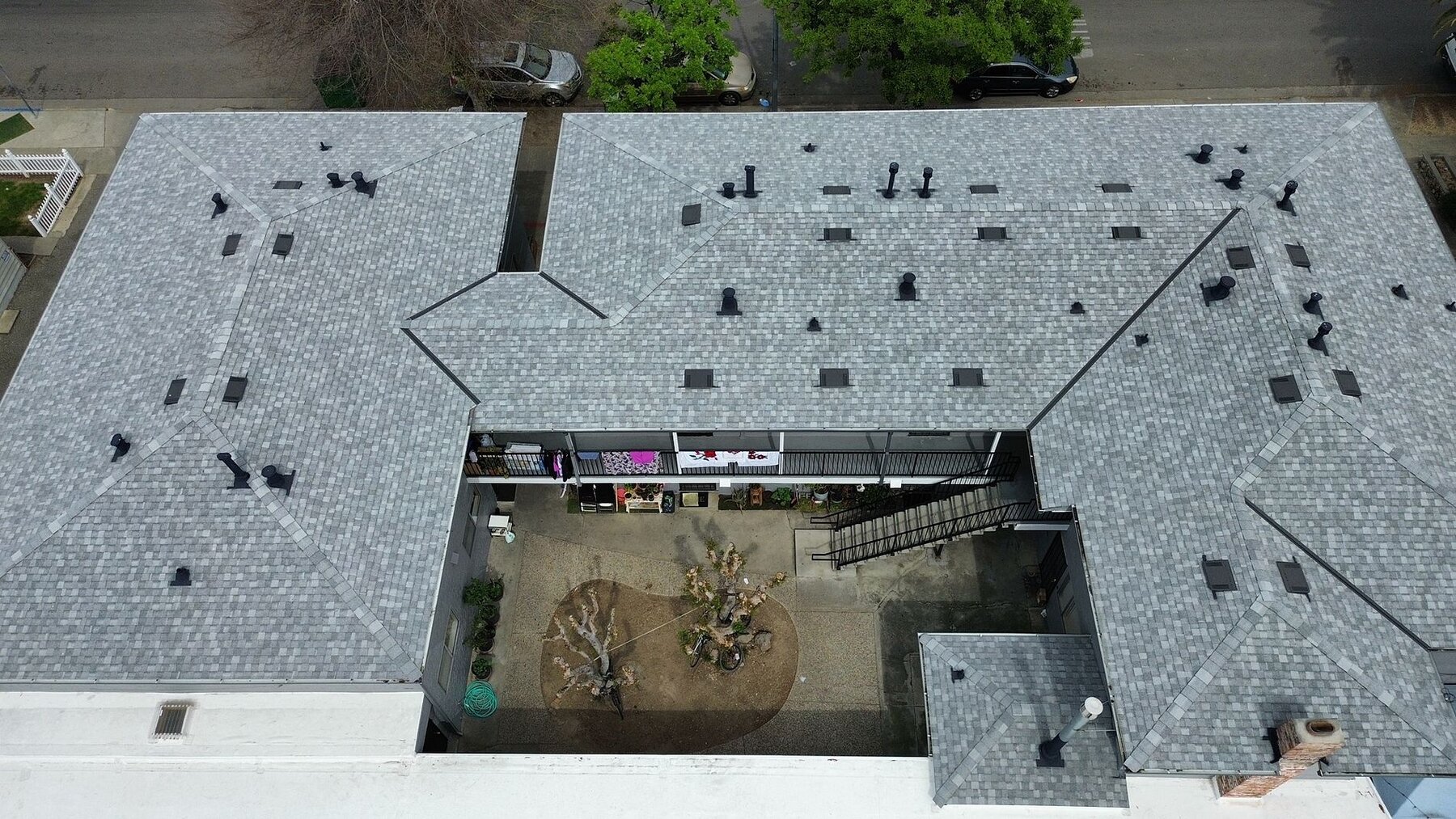
A full commercial re-roof on a family apartment building in San Jose — the kind of multi-scope project that older multifamily buildings need when deferred maintenance has compounded across decades. New plywood sheathing to strengthen the entire roof system, 30-year Landmark composition shingles on the pitched wings, single-ply on the flat carport decks, extensive dry rot repair, old fascia torn out and replaced with a new reliable gutter system. The transformation was dramatic — the property turned out absolutely beautiful from top to bottom.
Full Commercial Re-Roof
Multi-Scope, Multi-System
Older multifamily apartment buildings — the kind built in the 1950s through the 70s that still make up a meaningful share of San Jose's residential rental stock — are one of the most complex categories of roofing work. They're not single-family residential (scale is bigger, the structure is more complex, tenant coordination matters). They're not typical commercial (the roof carries the full weight of people's homes, not inventory or office equipment). They're their own category, and when they need a full re-roof, they usually need more than just new shingles.
This San Jose family apartment building is a textbook example. The existing roof had failed in multiple areas and was at end-of-life. Underneath, the plywood sheathing was too weak to support a new roof system — likely undersized for today's wind and seismic code, and degraded by decades of water infiltration from a failing inlaid gutter. An inlaid gutter system (common on this era of apartment construction) hides water damage inside the fascia cavity, so the dry rot was extensive by the time we opened up the roof. And because the building has both pitched main roofs and flat carport decks, a single shingle-only re-roof wouldn't have worked — the flat areas needed a different roof system entirely.
Our scope on this project: new plywood sheathing across the entire roof to strengthen the structure, 30-year CertainTeed Landmark composition shingles on all pitched wings, a single-ply membrane system on every flat carport deck, extensive dry rot repair wherever we found it (and we found it in most of the places we expected to), new fascia to eliminate the failing inlaid gutter system permanently, and a complete new seamless aluminum gutter system around the entire building — a reliable external gutter setup that replaces the hidden, failure-prone inlaid system once and for all. The transformation was dramatic. What the client called a "beautiful top-to-bottom" result is exactly that.
How We Scoped & Executed the Work
Multifamily re-roofs with this kind of compound scope need to be planned as a single project with tightly coordinated phases, not as four separate trades showing up in sequence. Tear-off, sheathing, dry rot, re-roof, fascia replacement, and gutters all interact — if any one scope is executed in isolation, the others get compromised. Our approach is to do all of it in a planned sequence with a single crew and a single foreman running the schedule.
Phase one is tear-off and structural strengthening. The old roof came off down to the existing deck, which exposed the full extent of the substrate condition. We then installed new plywood sheathing across the entire roof system — not patchwork replacement of the worst sections, but comprehensive re-sheathing to bring the deck up to current capability and to give the new roof system the solid substrate it needs to perform for 30+ years. Undersized or degraded sheathing is invisible when the roof is on; it's the single biggest reason re-roofs fail early on older apartment buildings.
Phase two is dry rot repair and fascia rebuild. With the deck exposed and the fascia ripped out, we could see exactly where water had been entering the structure — primarily through the failing inlaid gutter, secondarily at penetration flashings and valley transitions. We replaced rotted rafter tails, rebuilt compromised fascia sections with new pressure-treated lumber, and prepared the eave edges for the new external gutter system.
Phase three is the actual roof install. On the pitched wings: synthetic underlayment, starter course at eaves and rakes, Landmark composition shingles course by course with proper nail pattern, ridge caps, and color-matched pipe and vent flashings. On the flat carport decks: single-ply membrane mechanically fastened (or fully adhered depending on the deck condition), all seams heat-welded, proper flashing up parapet walls, and detailed termination at every penetration.
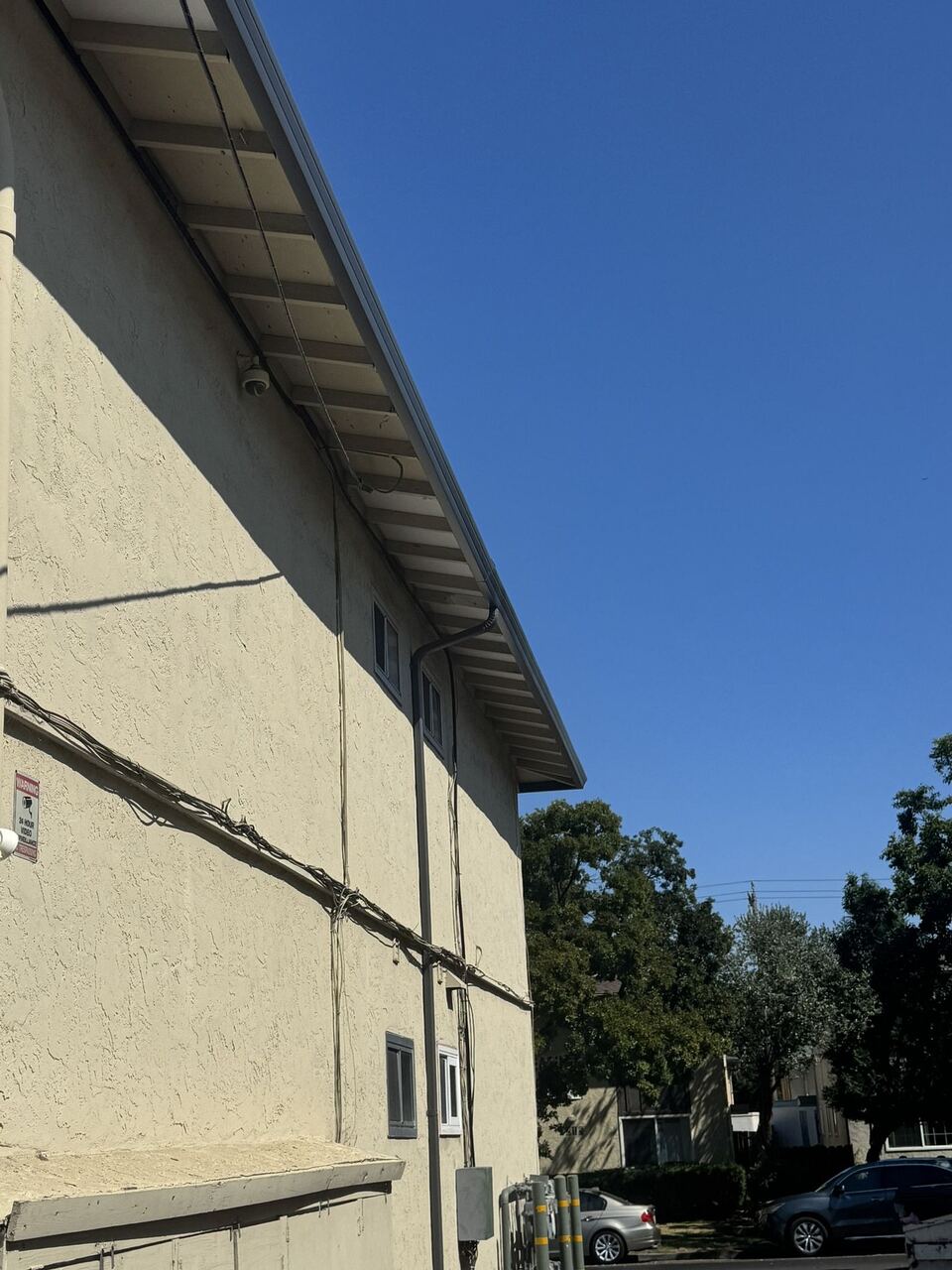
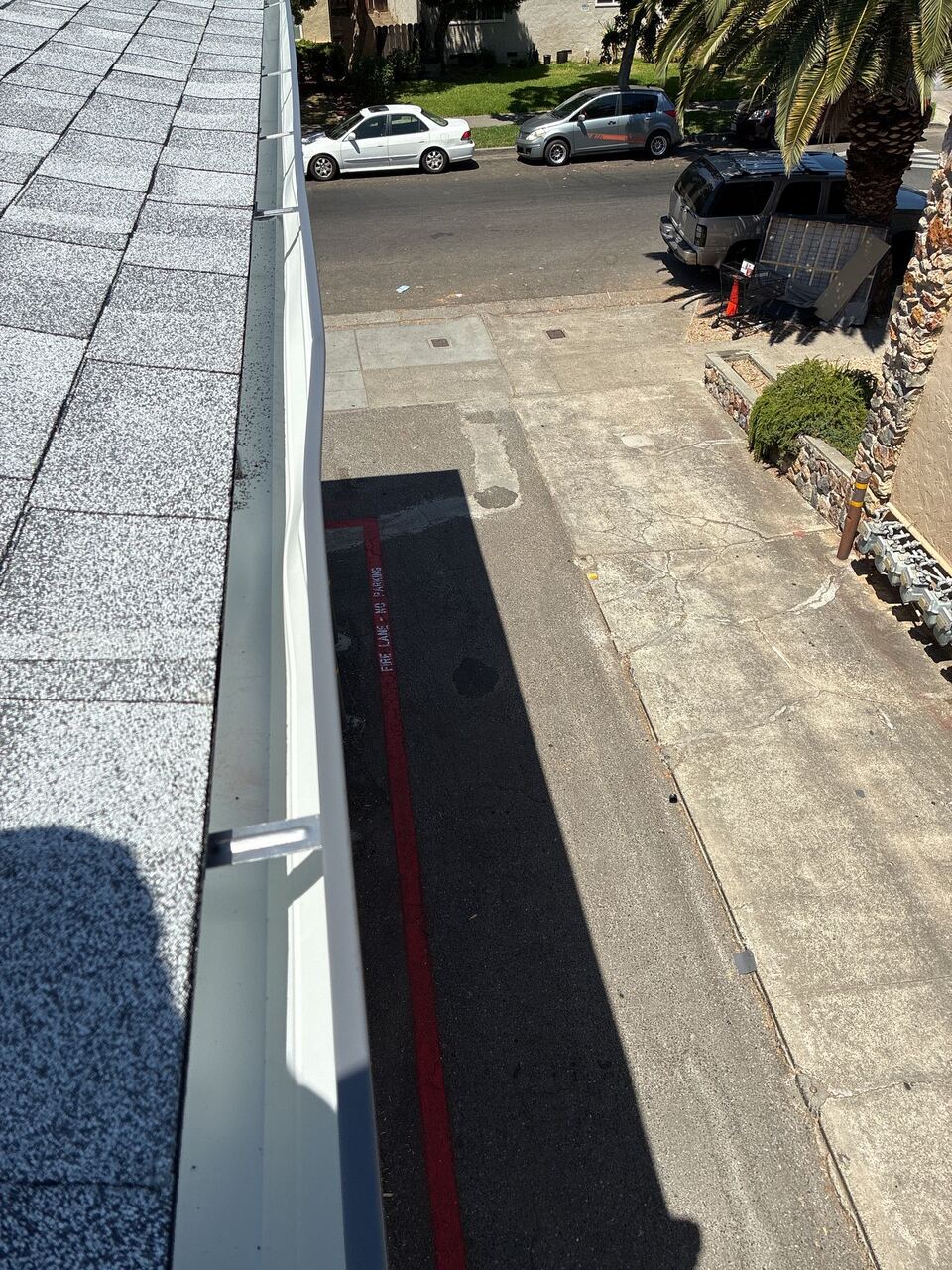
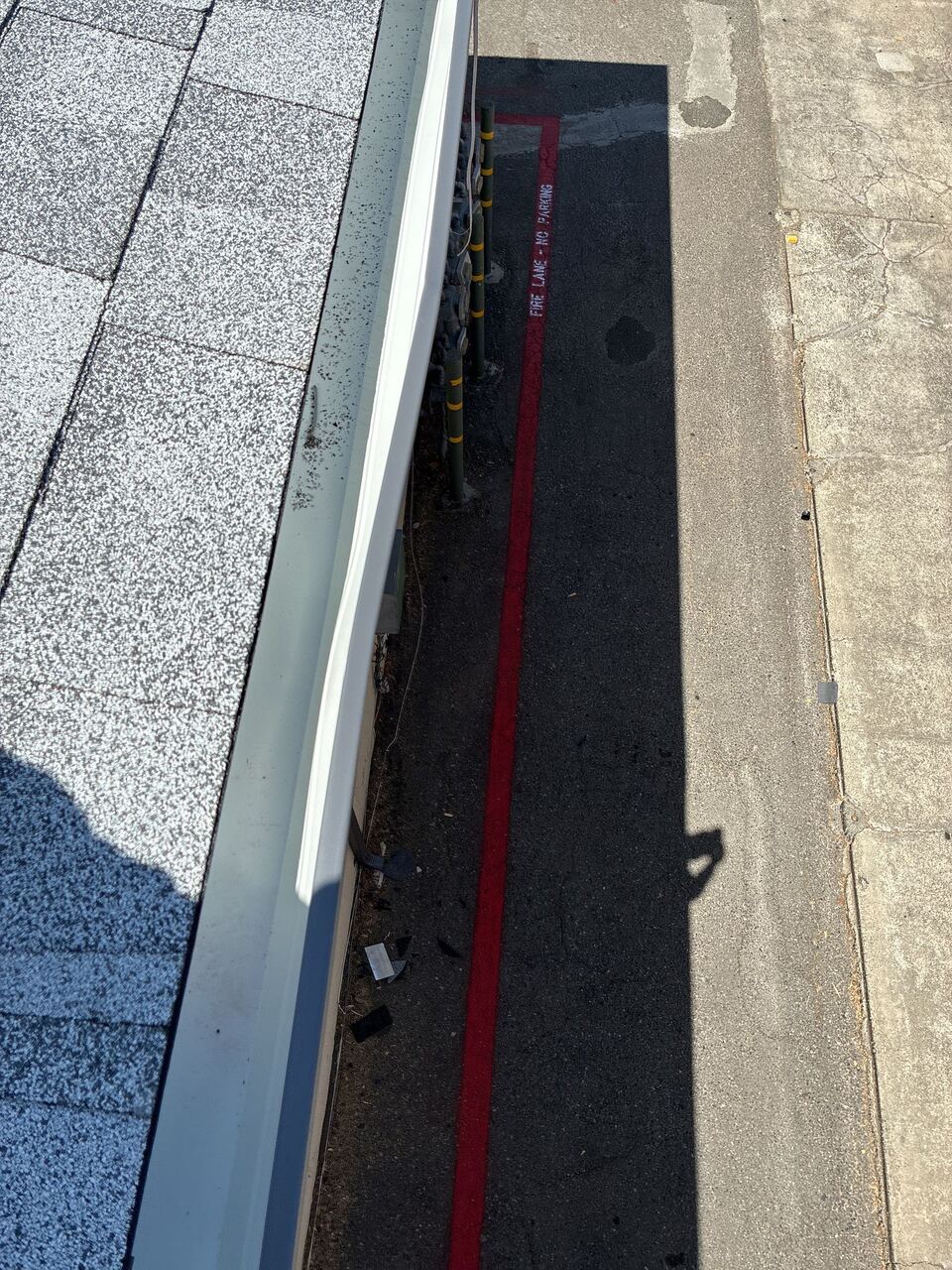
Phase four is fascia and gutters. New continuous fascia boards along every eave. New external seamless aluminum gutters fabricated on site to continuous runs, with integrated outlet hardware, properly sized for the roof area they drain, and new downspouts routed down the stucco walls to grade. This is the "reliable setup" that replaces the inlaid gutter system — every component externally mounted, every component individually inspectable and serviceable without opening up the structure.
Step by Step —
What We Did
Complete Tear-Off & Dumpster Staging
Full removal of the existing shingle layer and fascia assembly across the entire building. Multiple large dumpsters staged in the parking area for continuous debris clearing. Tenant vehicles and balconies protected with tarping. Work windows communicated in advance so residents know when crews will be on the roof above their units.
New Plywood Sheathing Across Entire Roof
New plywood sheathing installed across the full roof system to strengthen the substrate. Older multifamily buildings often have undersized or deteriorated sheathing that won't carry a new roof system for 30+ years — re-sheathing addresses that before it becomes a recurring failure mode. Nailing pattern and sheet layout coordinated with rafter spacing for full structural support.
Extensive Dry Rot Repair & Fascia Rebuild
Dry rot exposed during tear-off addressed wholesale — rotted rafter tails replaced, compromised fascia sections rebuilt with new pressure-treated lumber, and the failing inlaid gutter system fully removed. The new fascia detail is what makes the new external gutter system possible. This step is where older apartment buildings stop being "renovation projects" and start being reliable long-term assets again.
Landmark Composition Shingle Install (Pitched Wings)
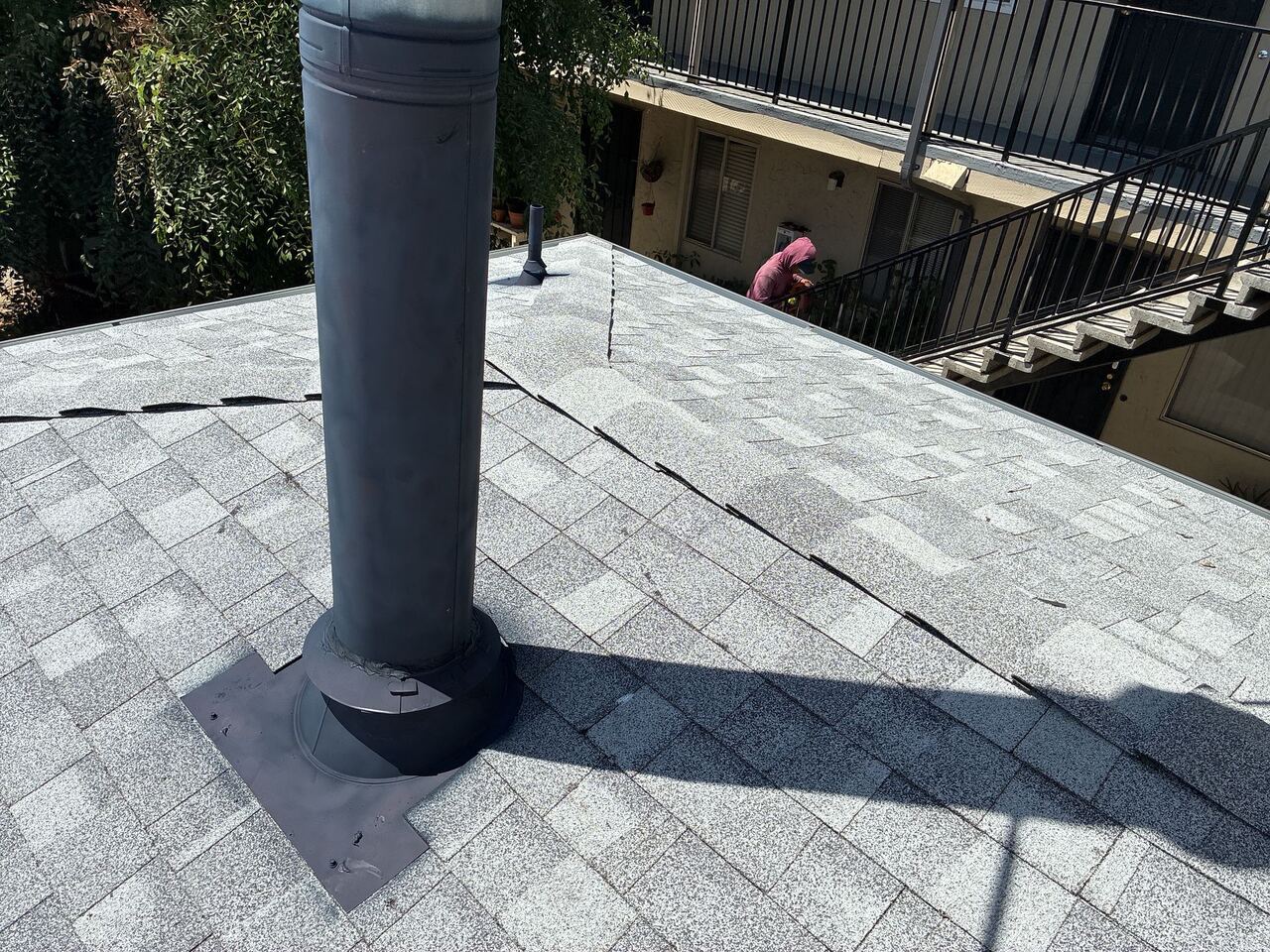
Synthetic underlayment installed across all pitched roof surfaces. Starter course at eaves and rakes. CertainTeed 30-year Landmark composition shingles installed course by course with proper nail pattern for the San Jose wind zone. Ridge caps installed along all ridge lines. Pipe boots and vent flashings color-matched to the shingle field so they recede visually.
Single-Ply Install (Flat Carport Decks)
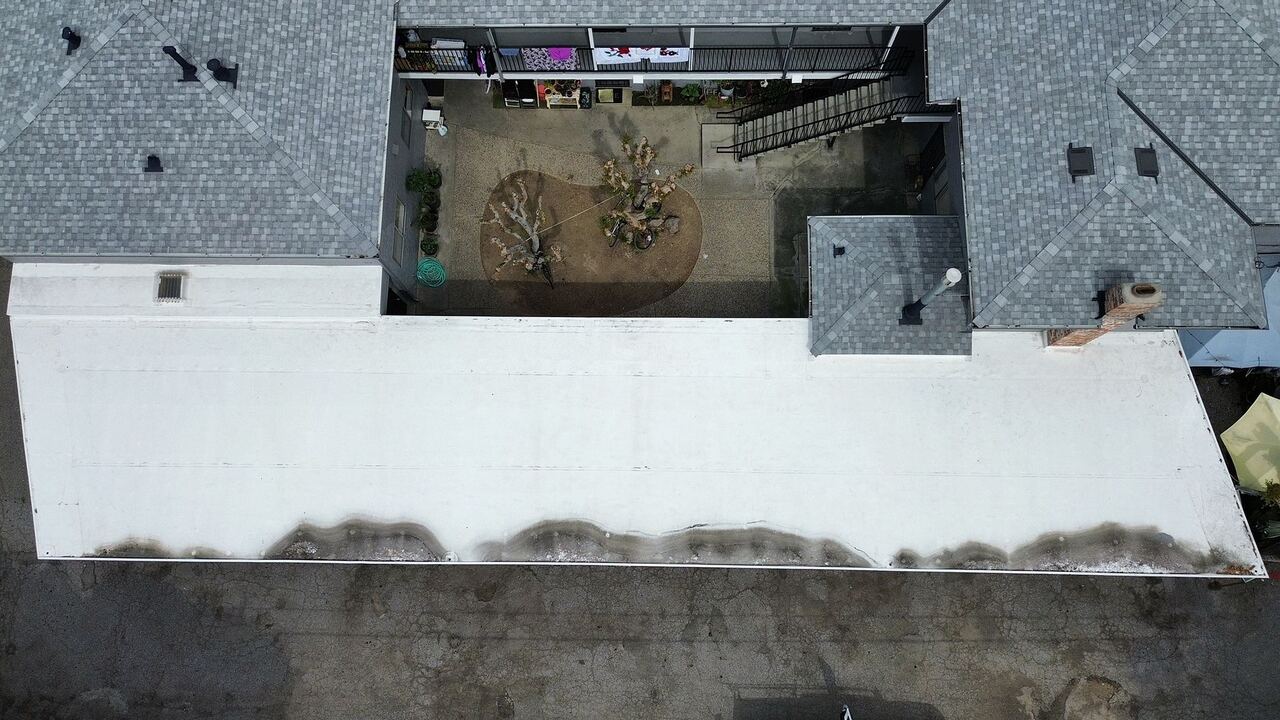
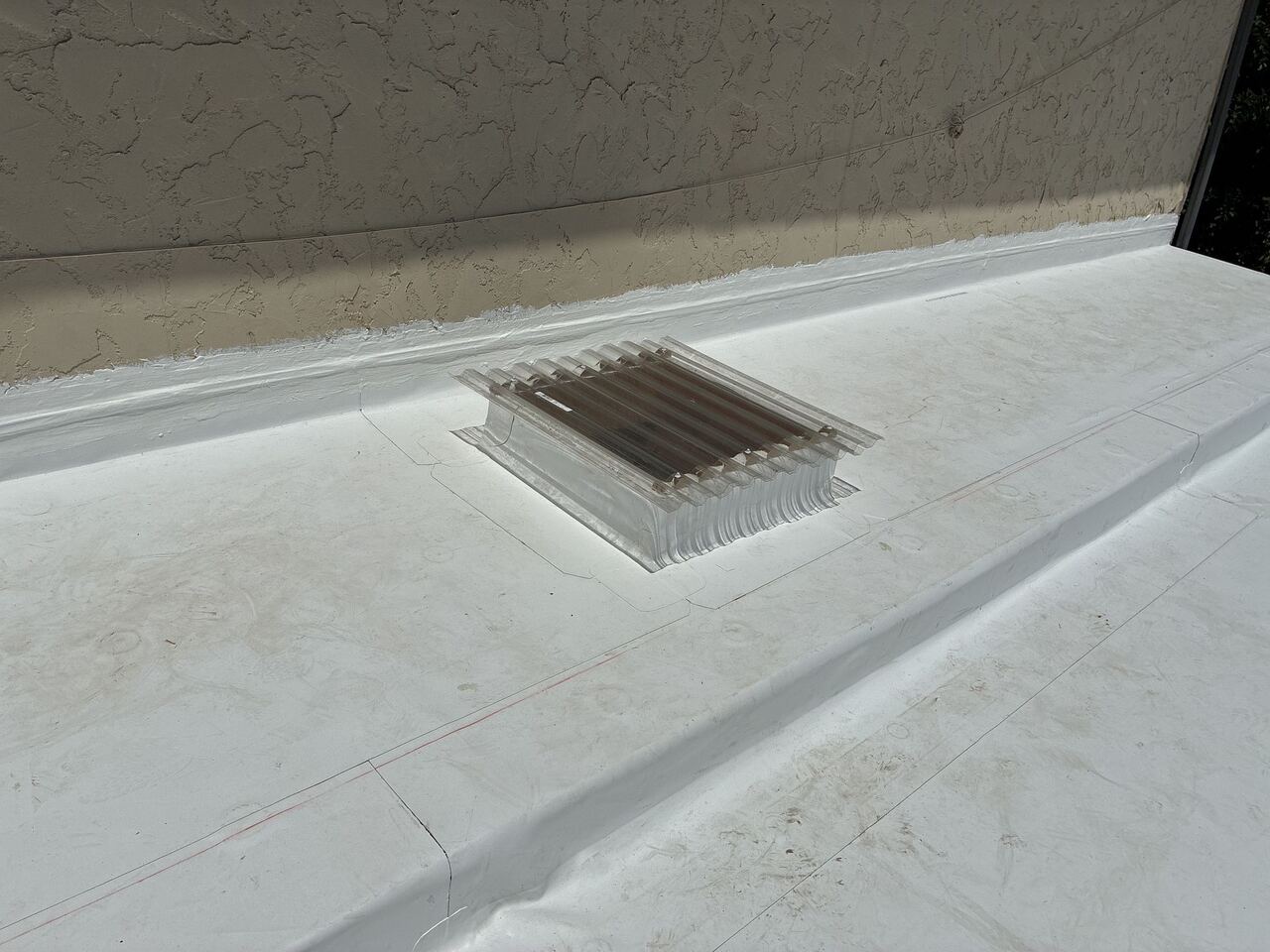
single-ply membrane installed across all flat carport deck surfaces — white reflective membrane for solar-heat rejection and long UV service life. All seams heat-welded on site for a continuous waterproof plane. Parapet wall terminations flashed up the stucco walls with proper counter-flashing. Skylights and penetrations detailed into the membrane with heat-welded target patches.
New Seamless Aluminum Gutters — Full Building Perimeter
New external seamless aluminum gutters fabricated on site, installed around the complete perimeter of the building. Outlets sized for the actual roof area draining into each section. New downspouts routed down the stucco walls to grade. This is the "reliable setup" that replaces the failing inlaid gutter system — every component is externally mounted, inspectable, and serviceable without opening the structure.
Final Walk-Through & Property Handover
Complete magnetic sweep of the property grounds for stray nails — essential for tenant-occupied buildings with shared parking. Final walk-through with the property owner or manager. Full photo documentation of before/during/after stages handed over for building records, warranty registration, and future maintenance reference.
Premium Materials
on This Project
CertainTeed Landmark 30-Year Composition Shingles
Dimensional architectural composition shingle with 30-year limited warranty, Class A fire rating, wind rating to 110 mph, and StreakFighter algae resistance. The workhorse of multifamily pitched-roof installations across California — strong long-term performance, wide color palette, manufacturer warranty that carries over at property transfer.
Single-Ply Membrane (Flat Carport Decks)
White reflective single-ply membrane on all flat carport deck areas. Heat-welded seams create a continuous waterproof plane — no mastics or sealants in the primary weather barrier, nothing that fails at joints over time. Single-ply is the right system for multifamily flat carports: low slope tolerance, high reflectance (reduces heat island effect), and 20-25 year manufacturer warranty.
New Plywood Sheathing Throughout
Complete new sheathing layer installed across the entire roof system to strengthen the substrate before the new roof was installed. Older multifamily buildings commonly have sheathing that's undersized by today's code and degraded by decades of water infiltration — re-sheathing is what makes the new roof a 30-year asset rather than a repeat problem.
Seamless Aluminum Gutters — External, Full Perimeter
New external seamless aluminum gutter system around the entire building perimeter. Fabricated on site to continuous runs (no mid-run seams that will eventually leak), properly sized for the roof area draining into each section, with integrated outlets and new downspouts routed to grade. The reliable external replacement for the failing inlaid gutter system.
New Pressure-Treated Fascia Boards
New fascia boards along every eave of the building — pressure-treated lumber for long-term moisture resistance, properly flashed at the new drip-edge termination, and detailed to support the new external gutter system. The fascia rebuild is what eliminates the inlaid gutter design permanently.
Synthetic Underlayment + Ice-and-Water Shield
Modern synthetic underlayment across the pitched roof decks — stronger tear resistance and better extended-exposure performance than 30-lb felt. Self-adhering ice-and-water shield at all eaves, in valleys, and around penetrations. These layers are the actual waterproof plane; the shingle is the UV and wind-resistant layer on top.
What the Client Got
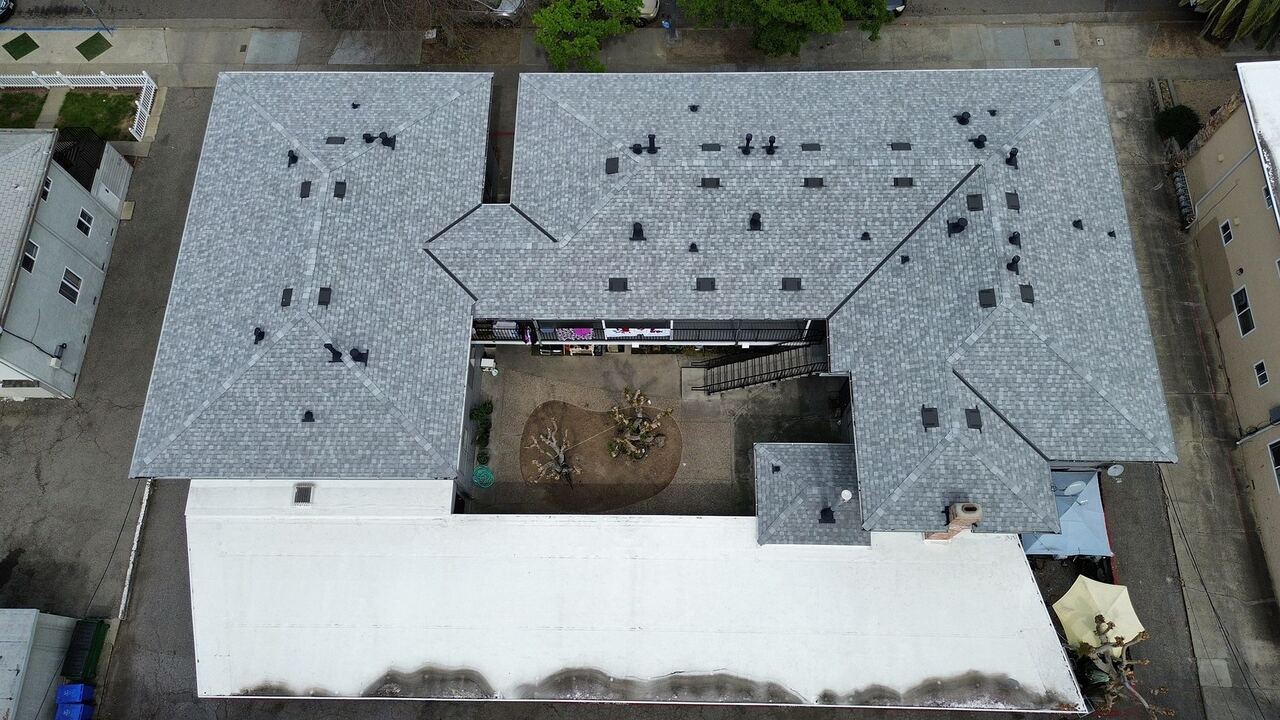
The transformation was dramatic. What was an old, failing, multi-area-damaged roof on an aging family apartment building is now a clean, properly structured, correctly detailed, beautiful roof from top to bottom. The aerial view is the payoff — the gray Landmark field reads as a single cohesive expanse across the pitched wings, the bright white single-ply on the carport decks gives the building the industrial crispness it never had before, and the new external gutters trace clean lines along every eave.
More importantly, the building is now set up as a long-term asset. New sheathing addresses the structural weakness that was invisible before tear-off. Dry rot repair eliminates a compounding maintenance problem that would have kept returning in different places for another decade. The external seamless gutter system replaces the single biggest source of hidden water damage on older apartment buildings. And the property owner has documented proof of a comprehensive scope-of-work, which supports tenant confidence, property valuation, and insurance coverage.
This is the kind of multifamily re-roof that turns an aging building from a recurring maintenance headache into a stable, well-performing rental asset. The property manager now has a roof that's predictable for the next 25-30 years — no more late-night calls about apartment ceiling leaks, no more mystery water damage tracing back to hidden inlaid gutters, no more patch-and-hope repairs. That's the transformation we take the most pride in.
Commercial Apartment Re-Roof — San Jose
Photo Archive
Why This Matters
in San Jose
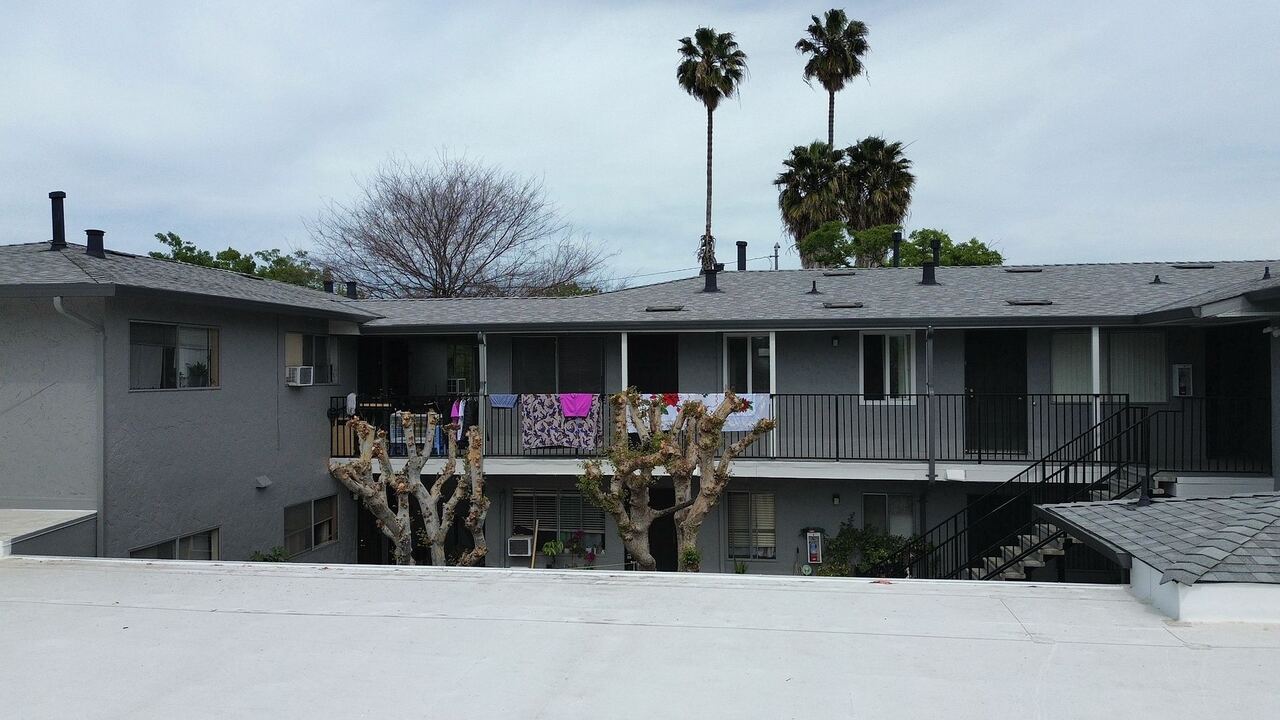
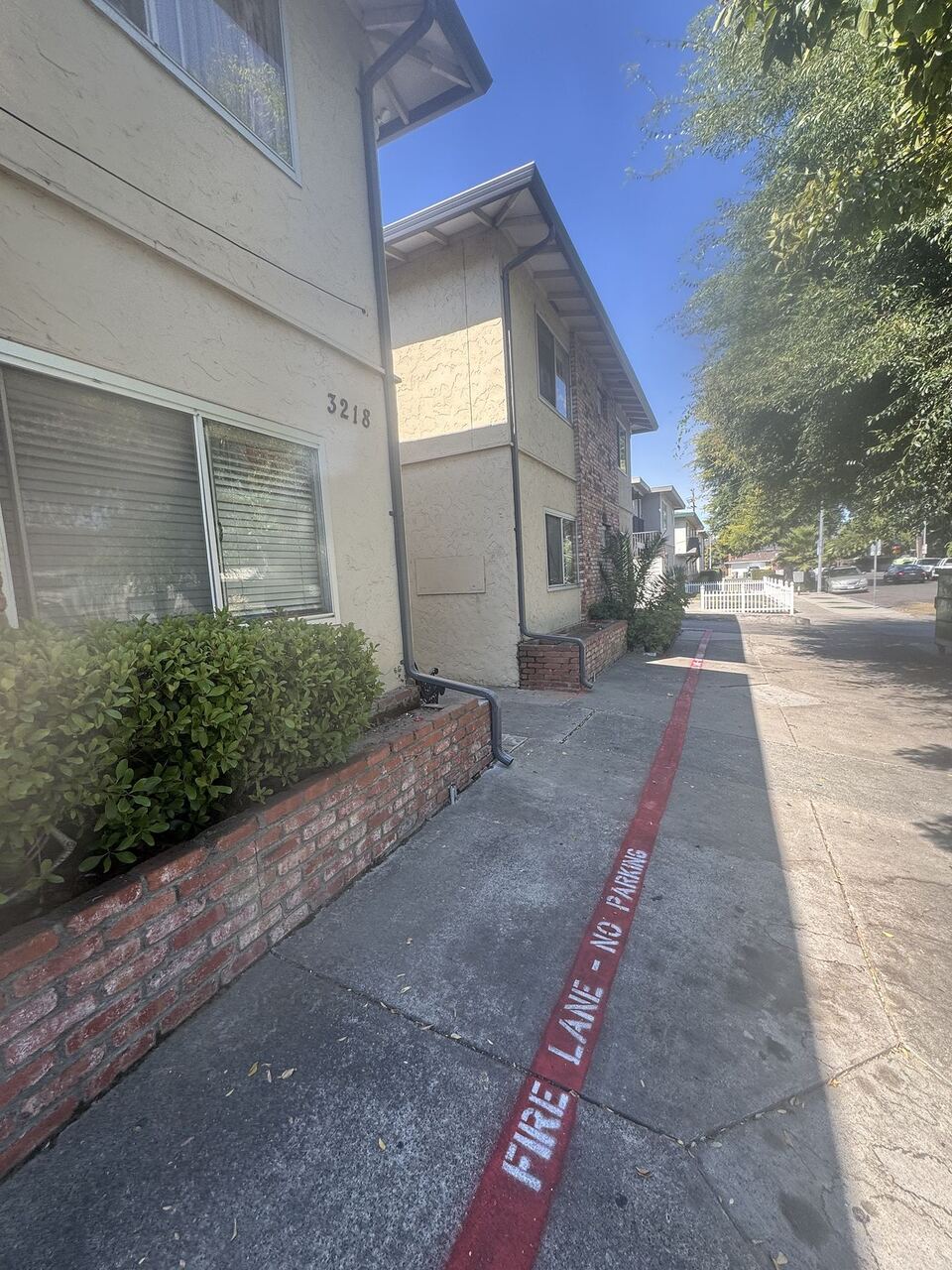
San Jose has one of the largest inventories of mid-century garden-style apartment buildings anywhere in California. The 1950s-70s apartment boom that built out neighborhoods across the city created thousands of family apartment buildings — two-story stucco-and-wood construction, courtyards, shared laundry, second-floor walkways — that now make up a foundational layer of the city's rental housing stock. Most of these buildings are somewhere between 50 and 70 years old, which means most of them have failing roofs, failing fascia and gutter systems, and accumulated dry rot that only becomes visible during tear-off.
The specific pattern we see across this category of building: inlaid gutter systems that have failed silently for years, undersized or deteriorated plywood sheathing, deferred maintenance compounded across multiple ownership transitions, and cumulative water damage inside the roof structure that was never addressed. Partial repair work on these buildings is almost always false economy — the hidden damage keeps resurfacing in new places, the cost adds up over time, and the building never stops being a maintenance liability. A single comprehensive re-roof with new sheathing, dry rot repair, and a new external gutter system (like this project) is usually significantly more cost-effective than the 10-year rolling repair bill that would otherwise keep accumulating.
The hybrid roof geometry is also specific to this building category. Mid-century San Jose apartment buildings commonly have pitched main roofs over the living units and flat decks over carports — two roof systems in one building, with very different performance requirements. Shingle on the pitched areas, single-ply or modified bitumen on the flat areas, and a properly detailed transition between the two at the parapet walls. Our Crown Blvd Commercial project is an example of pure flat-roof commercial work; this apartment project is the multifamily hybrid case where both systems have to work together on a single building. We do a lot of both.
Frequently Asked
About This Type of Work
Similar Projects
Commercial Roof Maintenance
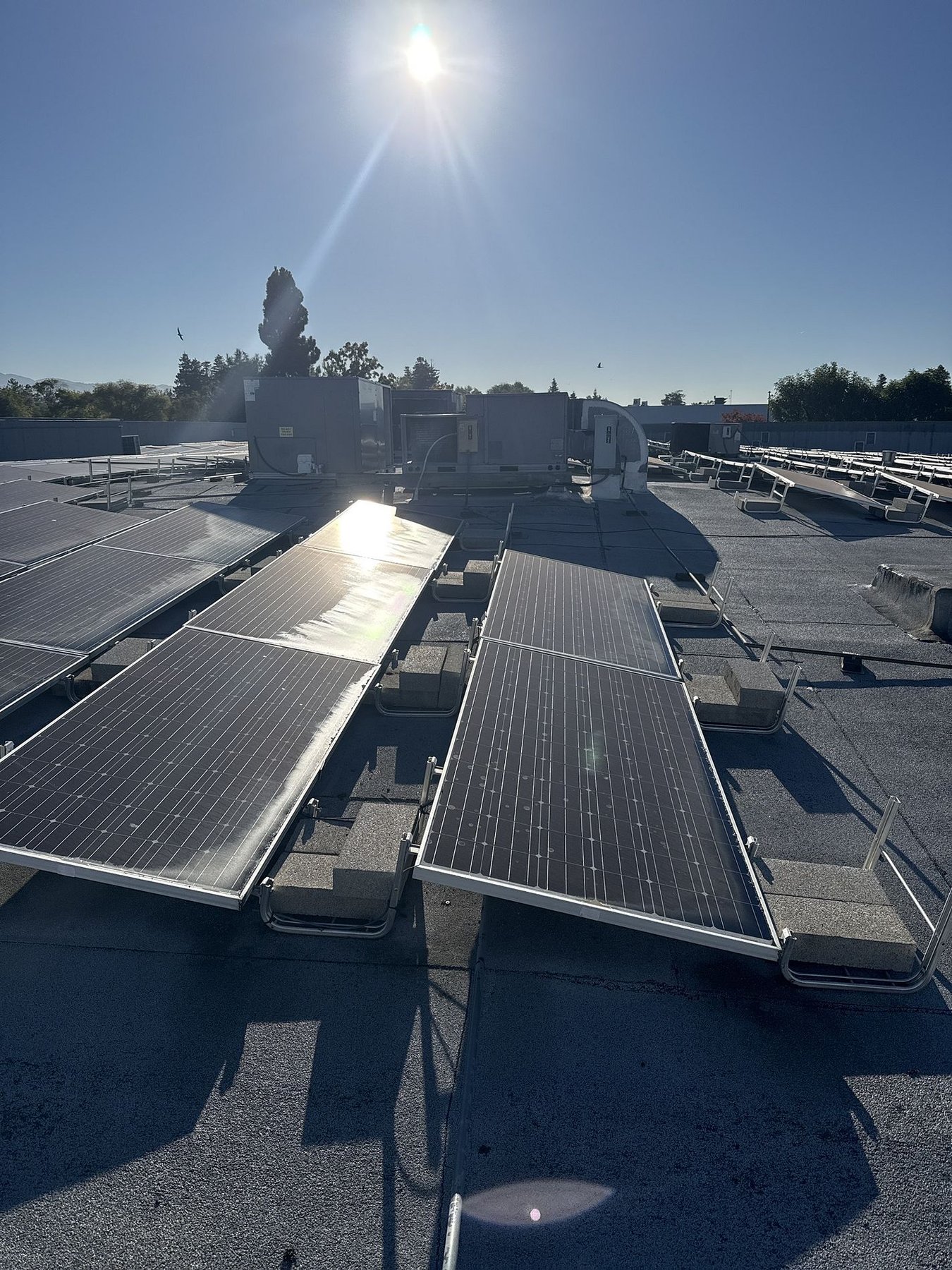
Full maintenance service on a commercial flat roof with extensive rooftop solar — inspection, penetration sealing, flashing work, and protective coating. The scheduled-maintenance counterpart to this full re-roof project.
Crown Blvd Commercial
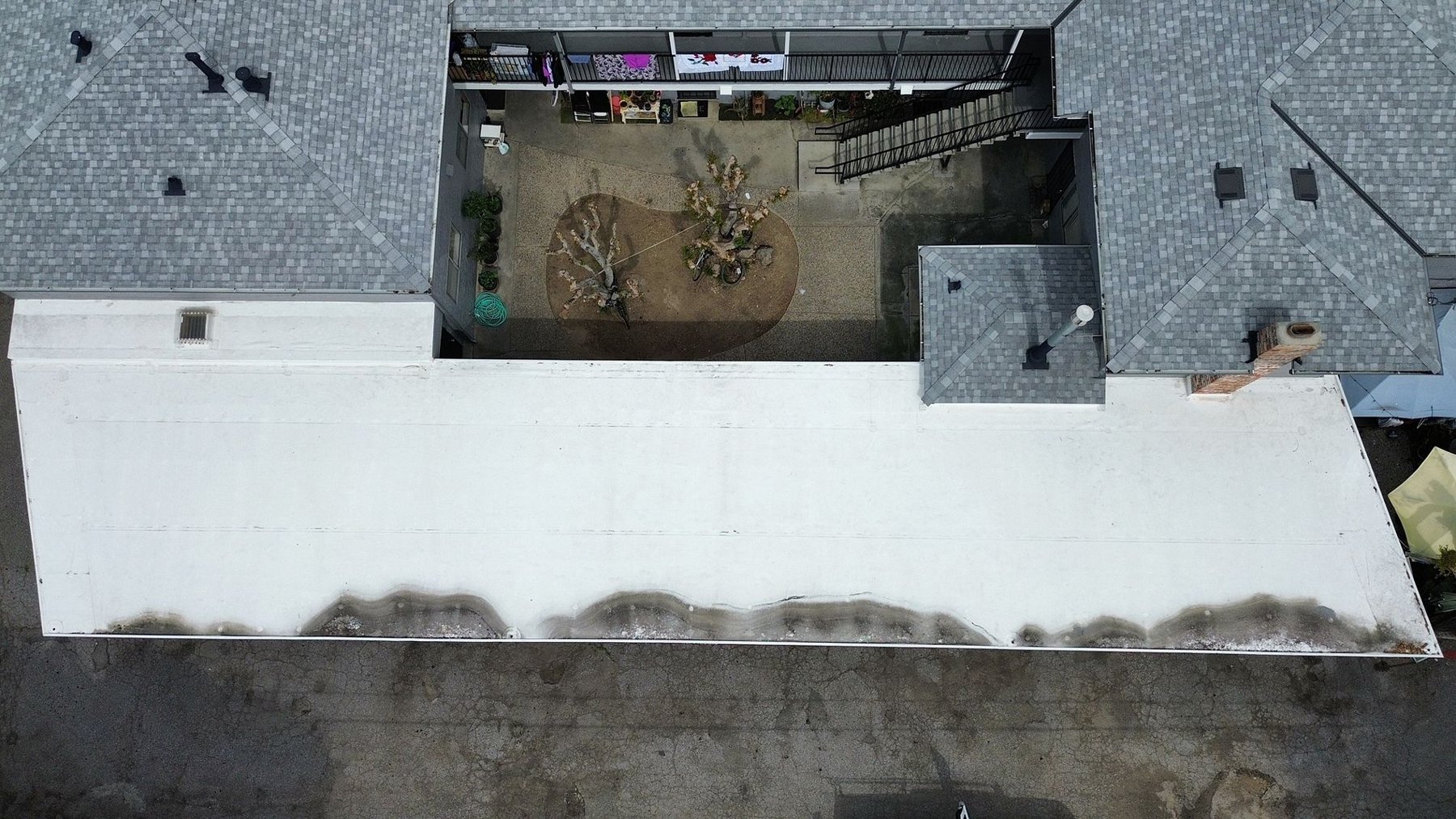
A 14,000 sq ft commercial flat-roof installation on Crown Boulevard — full tear-off, tapered insulation system, and single-ply membrane. Commercial-only work, no pitched areas.