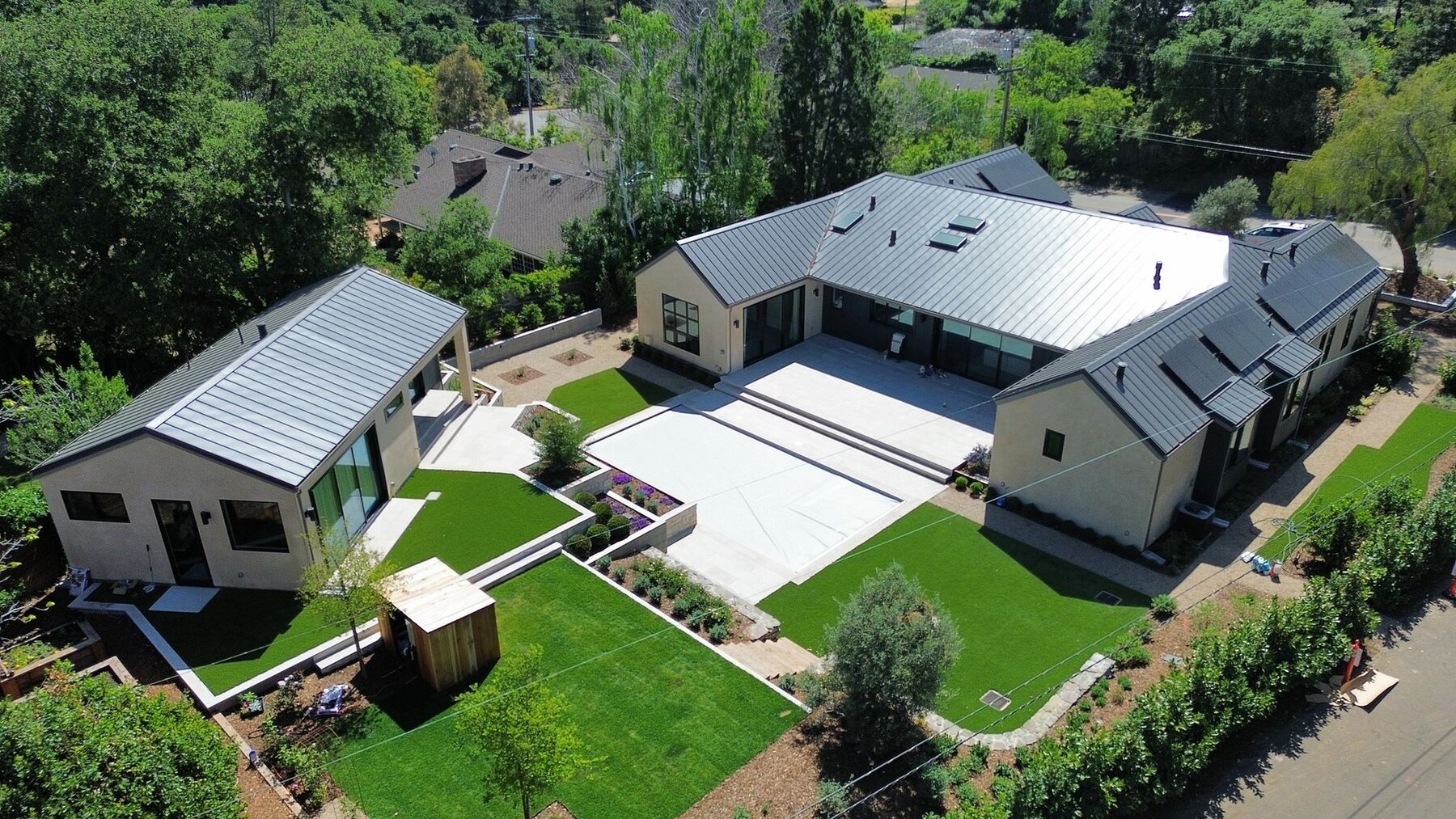
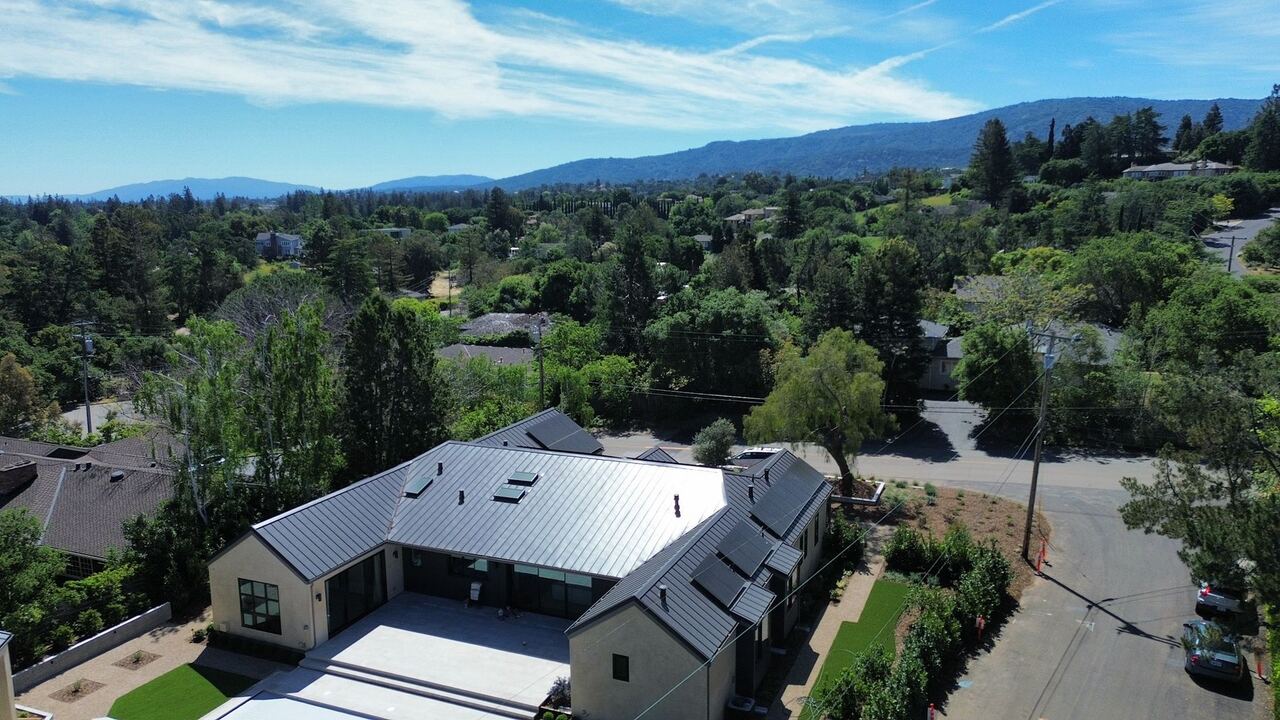
It is a fair question, and the honest answer is "it depends on the house and how long you're staying." Standing seam metal is a premium roof with real advantages in this climate, particularly on fire exposure and solar. It also costs meaningfully more up front, needs a crew that does it regularly, and simply doesn't suit every architectural style. This guide walks through the trade-offs the way we would at your kitchen table, using the standing seam roof we installed in Los Altos Hills as the running example.
What "Metal Roof" Means on a House
"Metal roof" covers several very different products, and it is worth knowing which one a bid is talking about.
Standing seam. Long panels that run from ridge to eave, joined along raised vertical seams that are mechanically locked or snapped together. The panels are held to the deck by concealed clips under the seams, so there are no exposed screws in the weather surface. This is the residential system most people picture, and the one this guide is about.
Exposed-fastener panels. Corrugated or ribbed sheets screwed straight through the face, with a rubber washer under each screw head. They are cheaper and common on sheds, barns and agricultural buildings. On a house, those thousands of washers become the maintenance item, because rubber ages in sun and heat.
Stone-coated steel. Steel pressed into the shape of shake, tile or shingle and coated with granules. It looks like a traditional roof from the street and behaves differently from standing seam in almost every detail.
When two bids both say "metal roof," ask which of these each one means, what gauge of steel or aluminium is specified, and what paint system is on it. Those three answers explain most of the price difference.
How Long It Lasts in the San Jose Climate
A properly installed standing seam roof with a high-performance finish typically lasts 40 to 70 years in Bay Area conditions. That is the range we give in our San Jose roof lifespan guide, alongside 20 to 30 years for asphalt shingle and 40 to 60 for concrete tile.
Two things explain the long life. First, the weather seal comes from the panel geometry rather than from sealant or rubber, so there is very little in the system that dries out in our long, hot summers. Second, the finish. On residential work the standard to ask for is a PVDF coating (sold as Kynar 500 or Hylar 5000), which resists fading and chalking under UV far better than the polyester paints used on agricultural panels. In a climate where a south-facing slope bakes from May to October, the finish is not a cosmetic choice.
What shortens a metal roof's life is almost always a detail, not the panel: a poorly flashed chimney or skylight, a pipe boot that wasn't built for metal, dissimilar metals in contact, or foot traffic by other trades. The roof deck underneath matters too. Standing seam goes over a solid deck and underlayment, so an older San Jose house with skip sheathing under its original shake will need that corrected at tear-off, exactly as it would for shingle.
Fire and the Hillside Neighbourhoods
A metal panel doesn't burn, and that is one reason metal is common in wildland-urban interface areas. But the thing that matters for code and for insurers is the fire rating of the whole roof assembly, not the panel alone. Standing seam steel systems are commonly listed as Class A assemblies when installed over a solid deck with the underlayment the listing calls for. Ask your roofer which listing the proposed assembly follows, and keep it with your permit records.
That matters most in the parts of our service area that back onto open hillside: the Almaden and Evergreen foothills, the hills above Los Gatos and Saratoga, and Los Altos Hills, where our metal project sits. Our guide to wildfire roof requirements in San Jose explains what Class A actually means and which details, like valleys and eave ends, embers exploit on any roof. A metal roof still needs those details done right. Open panel ends at the eave and gaps at the ridge are exactly where embers get in if they aren't closed off.
Summer Heat and California's Cool-Roof Rule
San Jose is in California Energy Code Climate Zone 4, and the state's energy code applies to re-roofing, not just new construction. Under the 2025 code (in effect since January 1, 2026), a single-family re-roof on a steep-slope roof in Climate Zone 4 generally has to meet a cool-roof minimum: an aged solar reflectance of 0.20 and a thermal emittance of 0.75, or a Solar Reflectance Index of 16. There are exceptions, including a ceiling insulated to R-38, a radiant barrier, or no ducts in the attic.
That is a modest bar, but it catches people out with metal in one specific way. Bare, unpainted metal reflects a lot of sunlight but has low thermal emittance, meaning it holds on to the heat it does absorb. So "metal is reflective" is not the same as "metal complies." Painted panels are rated product by product, and colour by colour, in the Cool Roof Rating Council directory. Ask for the rated values of the exact colour you choose, and make sure your roofer has checked them against the Climate Zone 4 minimum before the permit goes in. Dark colours are where you need to look most closely.
A lighter, reflective finish over a well-ventilated attic also makes a noticeable difference to upstairs rooms in a San Jose August. Our guide to attic ventilation covers the other half of that equation.
Solar Without Holes in the Roof
This is where standing seam has an advantage no other residential roof matches. On shingle or tile, every solar mount is a bolt through the roof into a rafter, flashed to keep the water out, and each one is a place a leak can start years later. On standing seam, clamp systems such as S-5! grip the raised seam itself. The racking attaches to the clamps, and the array goes on with no penetrations through the roof at all.
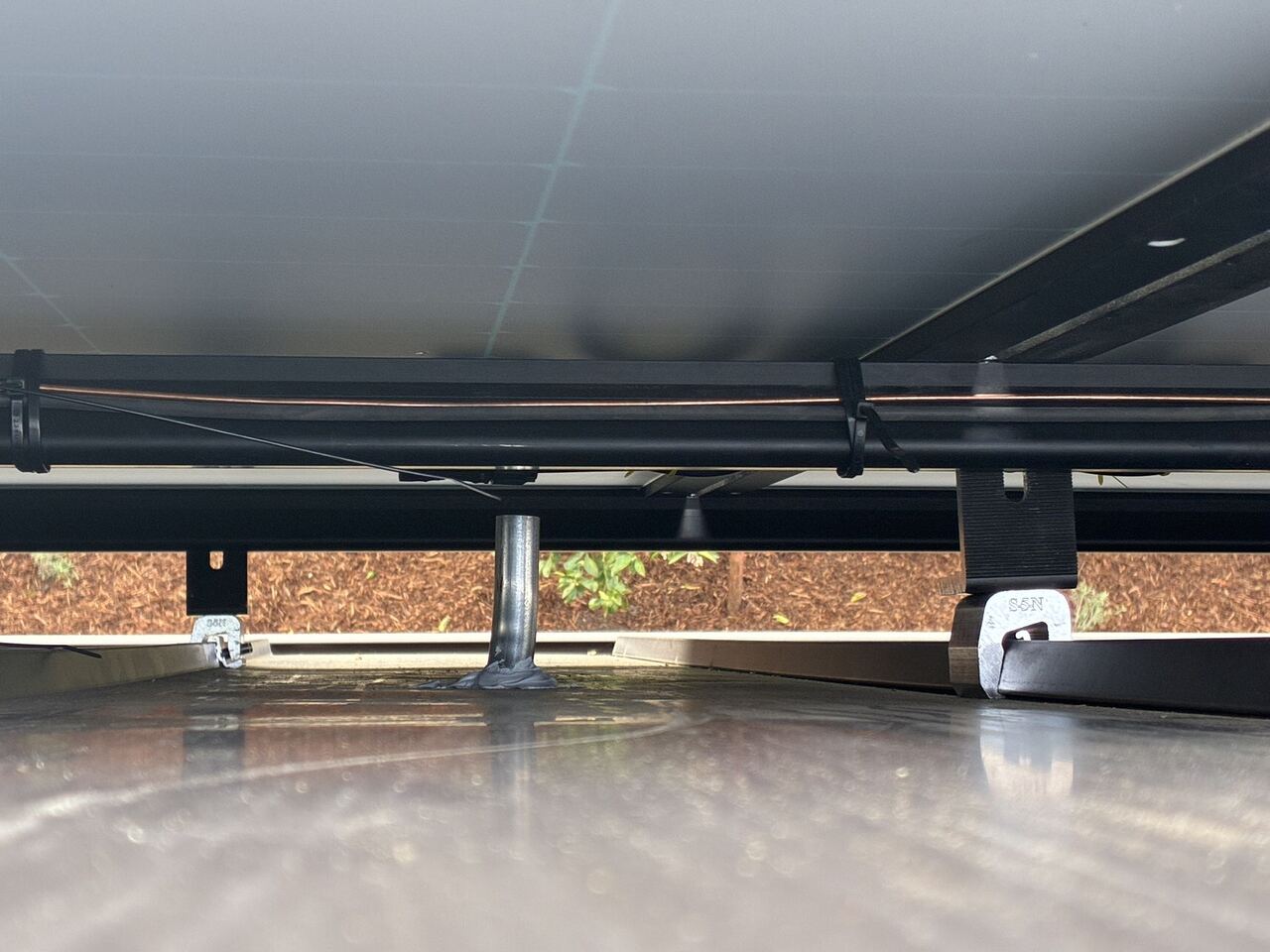
The Los Altos Hills roof was detailed that way from the start. A long-lived metal roof also removes the most common solar headache we see: a 25-year array sitting on a shingle roof with ten years left, which then has to be pulled off and reinstalled for a re-roof. Our guide to whether you need a new roof before solar walks through that sequencing for every roof type.
"Isn't It Loud When It Rains?"
It is the first question almost everyone asks, and it comes from barns and carports, where thin sheet metal spans open framing with nothing underneath. A residential standing seam roof is a different assembly. The panels sit on a solid plywood or OSB deck with underlayment, over an attic, over insulation, over a ceiling. It is those layers, much more than the metal on top, that decide how much rain you hear inside.
In practice, a standing seam roof over a solid deck and a properly insulated attic sounds much like any other roof in a winter storm. Where noise can be more noticeable is over vaulted ceilings with little or no attic space, or where the insulation is thin. That is worth raising during the estimate, because it can be addressed in the assembly before the panels go on.
Where Metal Is the Wrong Choice
We install standing seam and we like it. It still isn't the right answer for every house, and a good roofer should tell you when it isn't.
Up-front cost. Standing seam costs meaningfully more than architectural shingle and competes with clay tile. It tends to win on cost of ownership only if you're staying long enough to benefit from the extra decades. If you expect to sell in five years, a quality shingle roof is usually the better use of the money.
Architectural fit and approvals. Metal looks right on modern, farmhouse, and many ranch and mid-century homes. On a Spanish-style house with a clay tile roof, it usually doesn't. If you live in an HOA or a historic district, expect the material and colour to need approval before work starts.
Complex roofs. Every hip, valley, dormer and skylight on a metal roof is a custom-fabricated detail. On a cut-up roof with many planes, the labour cost rises quickly, and the quality of the crew matters more than the brand of panel.
Dents and oil-canning. Hail is rare here, but falling limbs from big oaks and sycamores are not. A heavy branch can dent a panel, and dents are repaired by replacing the panel, not patching it. Wide, flat panels can also show "oil-canning," a visible waviness in the flat of the panel. It is cosmetic, but some people notice it. Panel width, gauge and profile ribs all reduce it.
Specialist repairs. A shingle repair is something most roofers can do. A metal repair needs the right panel, the right trim and someone who knows the system, so choose an installer you expect to still be around.
Metal vs. Tile vs. Shingle at a Glance
Architectural shingle: the lowest up-front cost and the easiest to repair, with a 20 to 30 year life in our climate. The practical default for most South Bay homes. See our shingle roofing page.
Concrete tile: long-lived tile with an underlayment that typically needs renewal part-way through, and heavy enough that switching to it from a lighter roof needs a structural check. Our shingle vs. tile comparison covers it in depth.
Standing seam metal: 40 to 70 years, a fraction of tile's weight, Class A as a listed assembly, and the cleanest possible base for solar. The trade-off is up-front cost and the need for a specialist crew.
Weight is worth a word on its own. Because metal is so much lighter than concrete or clay tile, switching from tile to metal takes load off the structure, while switching to tile adds it. Either way, the permit and plan review for your specific house are what confirm it.
Deciding for Your Own House
A few questions sort most homeowners quickly:
How long are you staying? Metal pays back over decades. The longer you're staying, the stronger the case.
Is solar on the roof now or planned? If so, standing seam's no-penetration mounting is a real advantage over the life of the array.
Do you back onto open hillside? Fire exposure raises the value of a Class A assembly and ember-resistant detailing, whatever the material.
Does metal suit the house and the neighbourhood? If it would look out of place, or your HOA won't approve it, the decision is made.
How complicated is the roof? A simple gable or shed roof is ideal for standing seam. A roof with many valleys and dormers can still be done, but it costs more.
If metal still looks like the right fit, the next step is someone on the roof, not a brochure. A roof inspection tells you what the deck and attic look like and what a re-roof would involve, and our roof replacement team can price standing seam alongside shingle or tile so you can compare them properly. Keith Roofing Company has worked on San Jose roofs since 1952. Schedule a free estimate or call (408) 295-8616.
Frequently Asked Questions
Need professional help with your roof? Keith Roofing Company has been serving San Jose and the South Bay since 1952. We offer free estimates, honest recommendations, and work that's backed by BBB A+ Accreditation and CSLB License #1118418. Schedule a free estimate or call (408) 295-8616.