That second number is where trust gets made or lost. Handled properly it is a documented, photographed, signed change order for a defined quantity of sheathing. Handled badly it is a phone call on the second morning of the job that starts with "so, we found some rot." Here is what is actually under South Bay roofs, why the code sometimes removes the choice, and exactly what a legitimate deck charge has to look like.
The Part of Your Roof You Have Never Seen
The roof deck is the structural skin your roof covering is fastened to — the layer that spans between the rafters and gives the shingles, tile or membrane something to hold on to. It carries the weight of the roof, the weight of anyone walking on it, and the fastening load of every nail in the assembly. It is also completely invisible: covered on top by the roof, covered underneath by insulation, and visible only in the narrow strips an attic hatch happens to reveal.
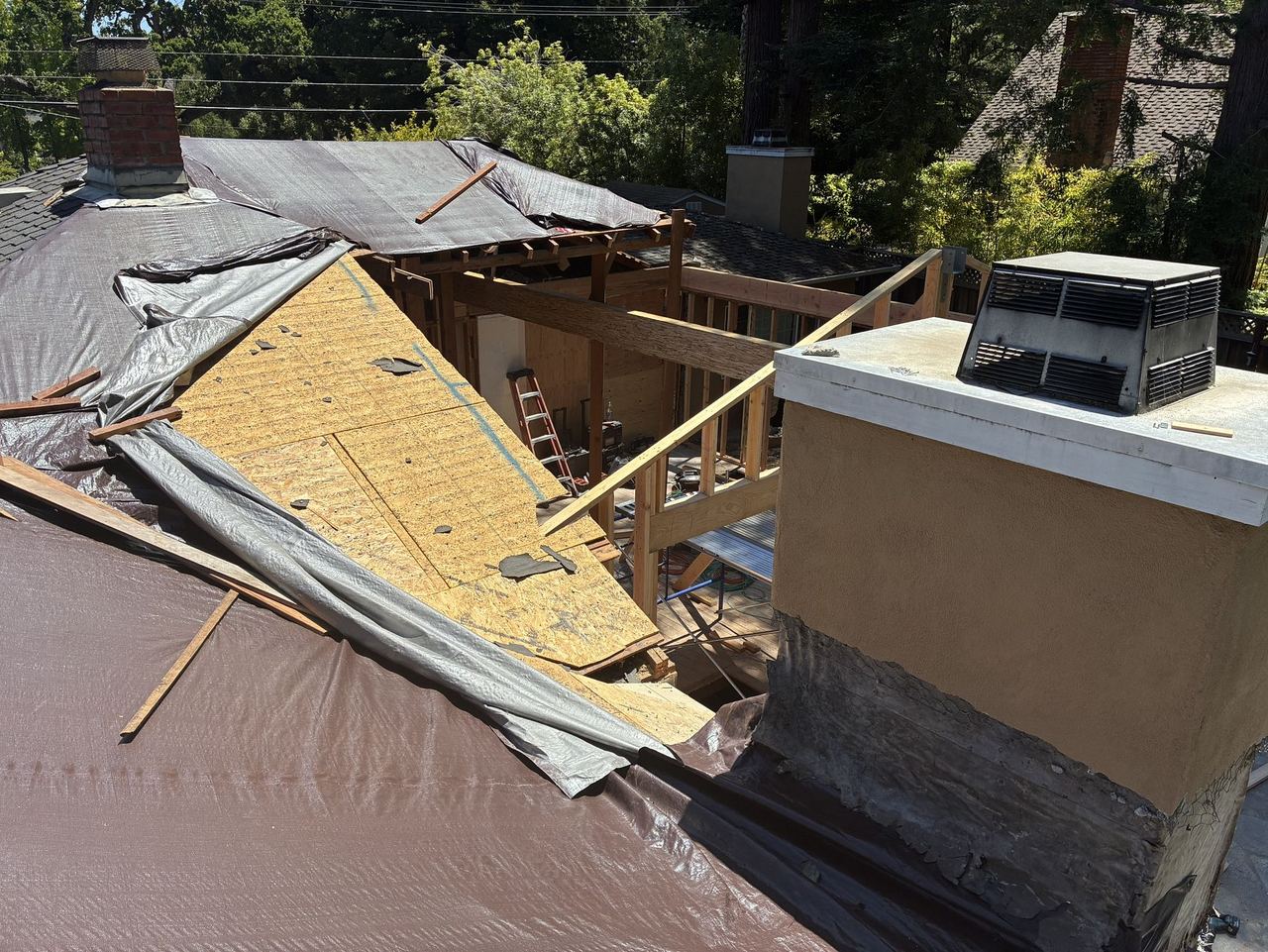
That invisibility is the whole problem. A roofer standing on your roof is reading it indirectly — soft spots underfoot, deflection between rafters, staining at the eaves, the sound a nail makes going in. Those are good signals and an experienced crew reads them well, but they are inference, not inventory. Nobody knows the true condition of a deck until the covering comes off, which is why a re-roof contract can be honest, complete and detailed and still change once the tear-off starts.
What separates a well-run job from a bad one is not whether the deck surprises anybody. It is whether the contract anticipated the surprise.
Three Kinds of Deck Under South Bay Houses
Because San Jose built out in distinct waves, the deck under your house is largely a function of when it went up.
Spaced or skip sheathing — 1x6 boards laid with gaps between them — is what went under wood shake and shingle roofs, and it is standard on the older housing stock in Willow Glen, the Rose Garden and the pre-war pockets around downtown. The gaps were deliberate: shake needs to breathe from below. Nothing modern does.
Solid board sheathing — the same 1x6 stock laid tight — shows up through the mid-century tracts. It is a genuine solid deck and it is usually fine, though individual boards split, cup and pull loose over seventy years.
Plywood and, on newer work, OSB became the norm as the valley filled in through the 1960s and after. Half-inch and 7/16-inch panels are what you will find on most of Almaden Valley, Blossom Valley, Evergreen and Campbell. Plywood is strong and predictable, and it is also the material that delaminates most dramatically once water has been sitting on it.
Any of the three can be in excellent shape at sixty years old. All three fail in the same places for the same reason.
Dry Rot Is a Moisture Problem, Not an Age Problem
"Dry rot" is a misleading name for fungal decay in wood, and the fungus needs moisture to work. Wood that stays dry does not rot, no matter how old it is. Wood that is repeatedly wetted — even lightly, even briefly — eventually does.
Our climate delivers that pattern almost by design. The South Bay spends roughly half the year bone dry under hard UV, which cracks the flexible parts of a roof: pipe boot gaskets, exposed sealant at flashing terminations, plastic vent housings. Then the rain arrives concentrated into a handful of atmospheric river events and tests every one of those cracks at once. A boot that split in August does not announce itself in the ceiling; it just admits a little water at each storm, into a dark cavity with almost no air movement, where the wood never quite dries out between events. Give that four or five winters and you have soft sheathing that nobody inside the house ever knew about.
This is also why attic ventilation belongs in a conversation about decking. An under-ventilated attic holds moisture against the underside of the sheathing all winter, so the deck is being attacked from both faces at once. On tear-offs where the decking is broadly poor rather than locally poor, the ventilation is very often the reason.
Where It Concentrates, and Why It Stays Hidden
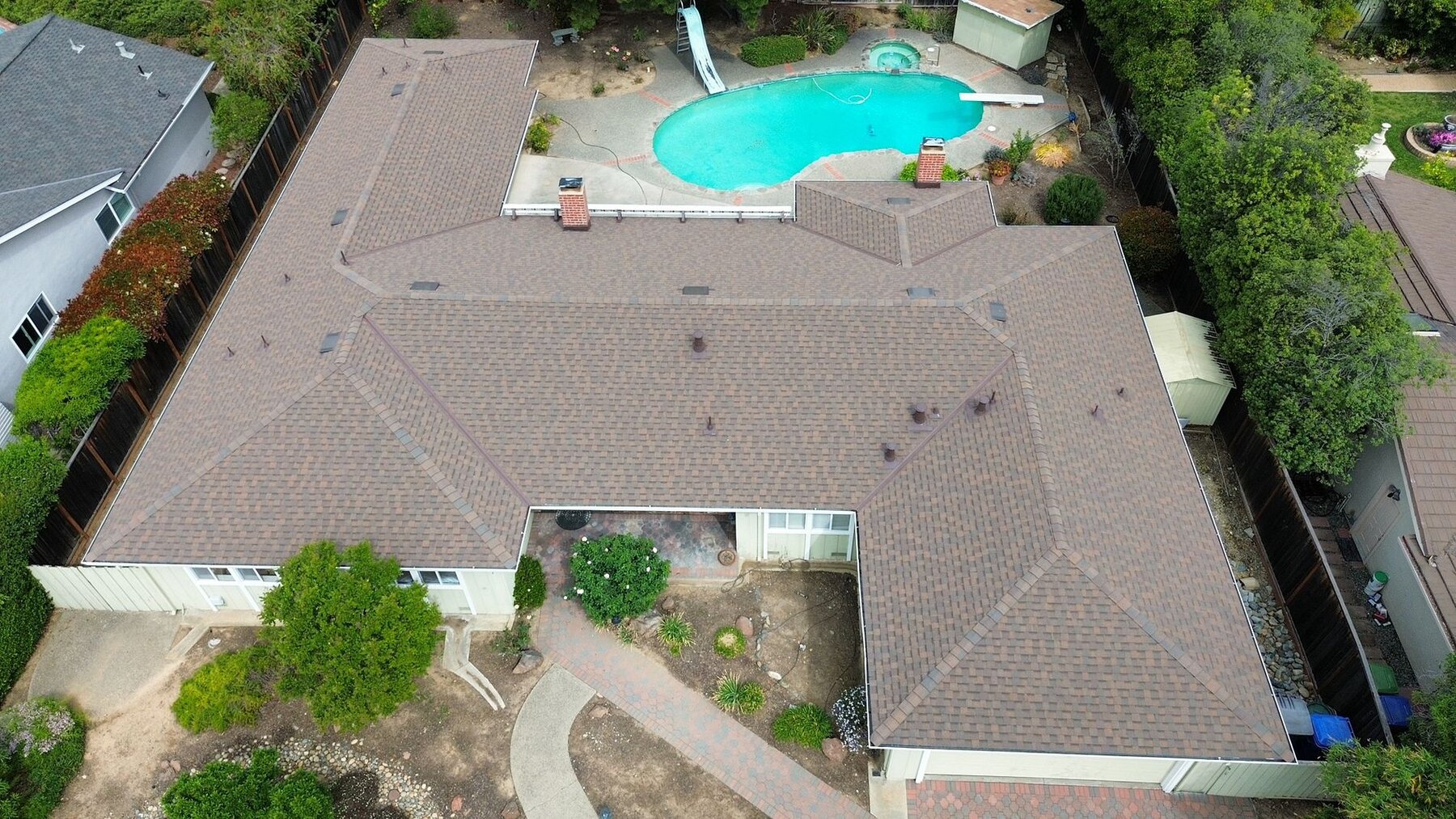
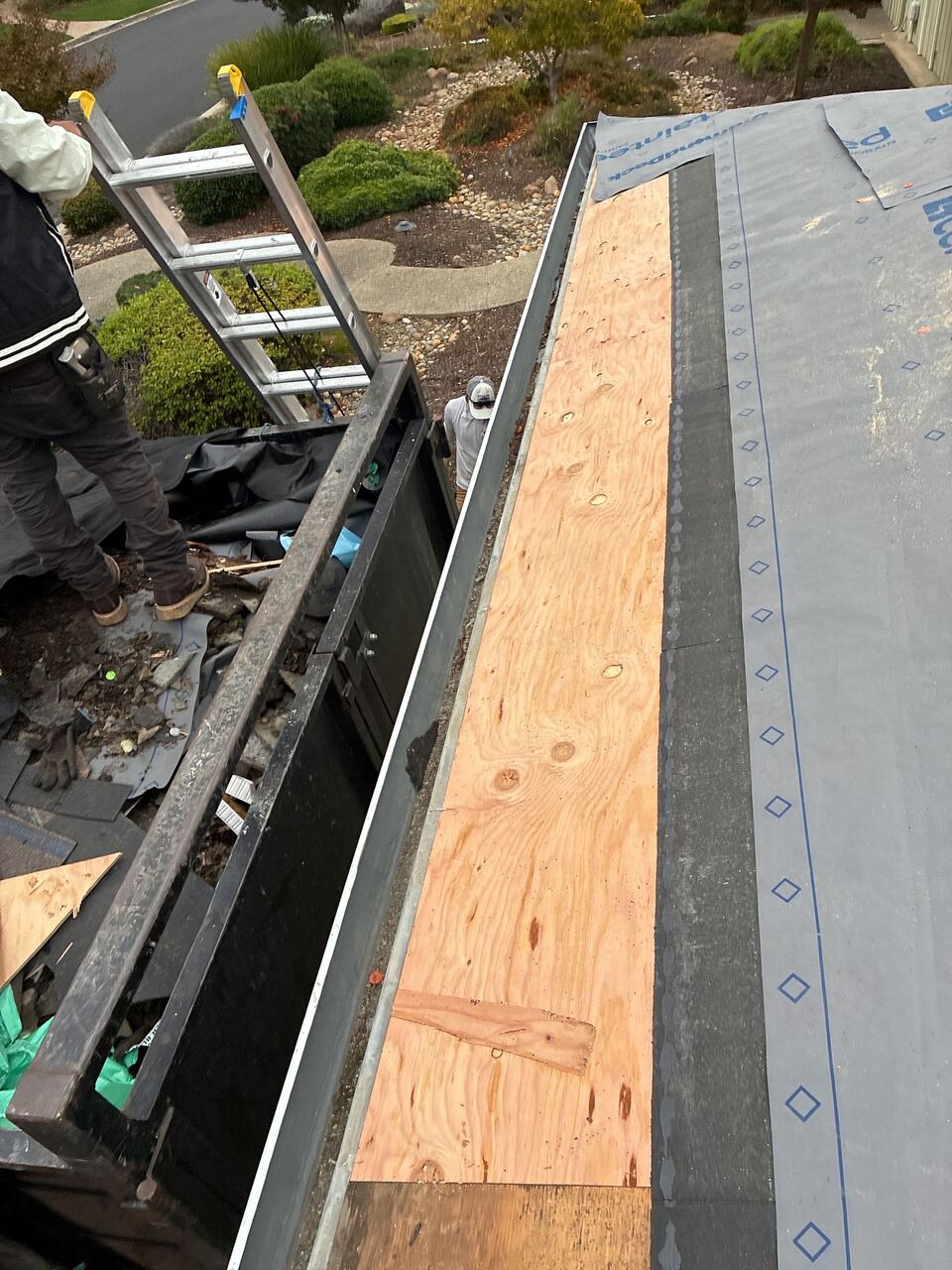
Decay follows water, and water on a roof follows a small number of predictable routes. On the Campbell tar-to-shingle conversion, where a built-up roof had been leaking quietly for years, the substrate damage was concentrated exactly where you would expect it: around penetrations, in the valleys and along the eave lines.
Eaves and the first few courses. Water backing up out of a blocked gutter runs under the bottom course and sits on the deck edge and the fascia behind it. This is the single most common location, and it is also the one most often invisible from the attic because the eave is outside the insulated envelope.
Valleys. Every valley concentrates the runoff of two roof planes into one line, and in this valley they also collect oak, redwood and eucalyptus litter that holds moisture against the surface long after the rain stops.
Chimneys and sidewalls. Counter-flashing and step flashing are where amateur repairs pile up. Three generations of sealant over a flashing detail that was wrong to begin with will keep a chimney "fixed" for years while the deck behind it quietly goes.
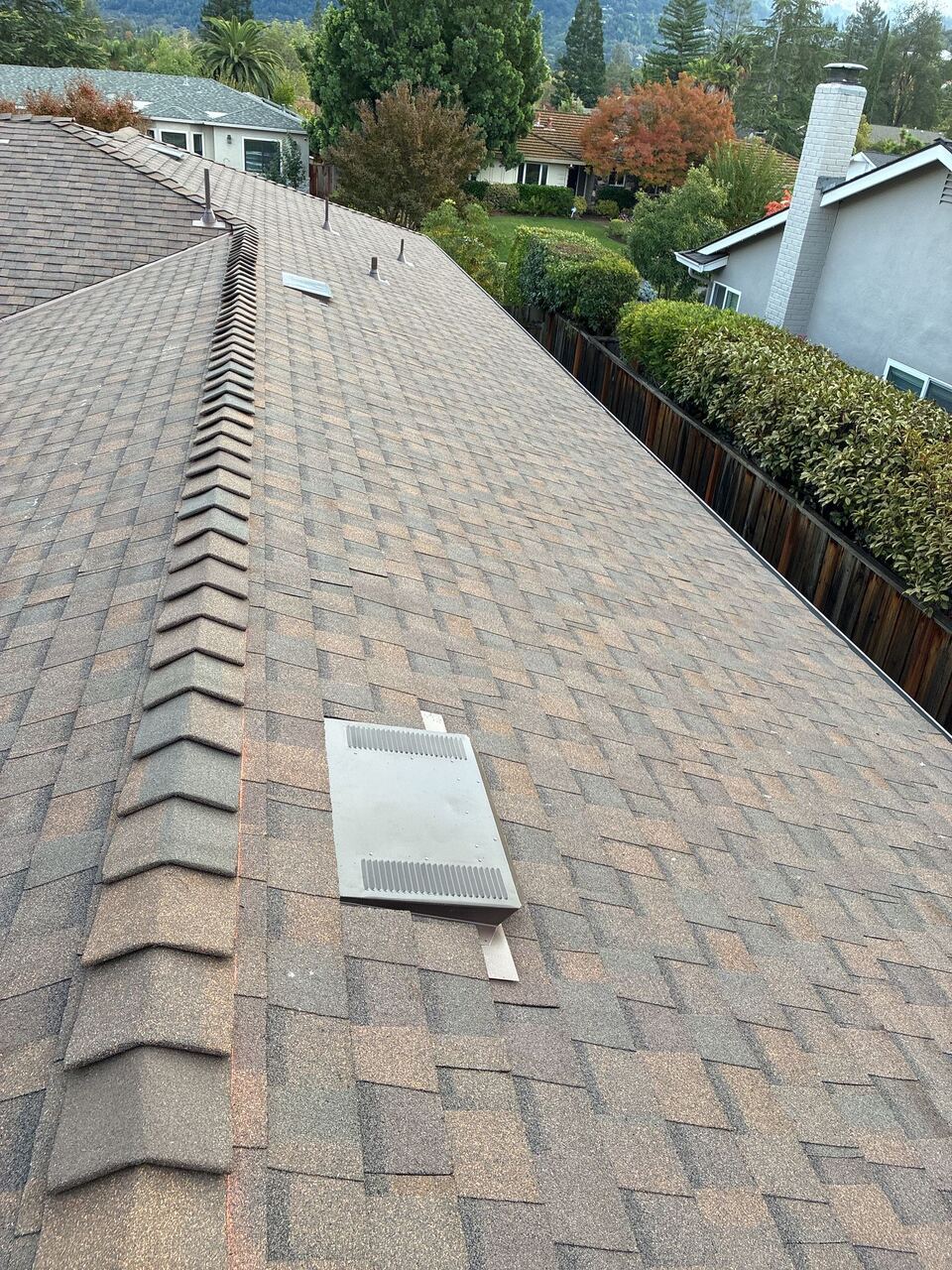
Penetrations. Plumbing vents, furnace and water heater flues, bath fans, skylight curbs, and — increasingly — solar standoffs. Each one is a hole in the roof with a manufactured part keeping the water out, and manufactured parts have service lives.
Notice that every one of those is a place a roof inspection looks specifically, which is why an inspection before you buy a roof is worth far more than its cost.
When the Code Decides for You
Sometimes deck work is not a judgment call at all. Three provisions in the Residential Code's roofing chapters do the deciding.
Asphalt shingles need a solid deck. Section R905.2.1 is one sentence long: asphalt shingles shall be fastened to solidly sheathed decks. There is no exception for "mostly solid," and no version of it that accommodates gaps. If you are putting composition shingles on a spaced deck, the deck has to be made solid first.
Tile is nearly the same story here. R905.3.1 requires concrete and clay tile over solid sheathing, with an exception permitting spaced lumber sheathing — but that exception is written for Seismic Design Categories A, B and C. Bay Area residential construction sits in the higher categories, which is why tile in Santa Clara County is specified over solid sheathing in practice. Your building division assigns the seismic design category for your parcel and is the right place to confirm it.
You cannot roof over a bad deck. Section R908.3.1.1 rules out a roof re-cover — going over the existing roof rather than tearing it off — where the existing roof or covering is water soaked or has deteriorated to the point that it is not an adequate base, where there are already two or more applications of any roof covering, and on slate, clay, cement or asbestos-cement tile. In other words, the cheapest possible answer to a soft roof is not a lawful one.
Why this shows up as a change order and not a line item. Because a permitted re-roof is inspected, deck work found during tear-off has to be corrected before the new roof covers it. It cannot be quietly skipped to protect a number — which is exactly why it needs a price everyone agreed on in advance.
Skip Sheathing: The Boards Under Old Willow Glen
Skip sheathing deserves its own section because it is not damage — it is a design from another era that modern materials cannot use. The 1x6 boards spaced with gaps were exactly right for cedar shake, which needed airflow at its underside. Composition shingle needs the opposite: continuous support under every nail.
Where this goes wrong is when an earlier re-roof ignored it. Shingles installed over open gaps lose fastener holding and support in the spaces between boards, and they fail early and unevenly over those gaps. If a previous owner put composition over shake-era decking, that history is often visible in the wear pattern from the street.
The remedy is usually an overlay rather than a demolition. On a 1928 bungalow in Willow Glen we planned for skip sheathing before the job started, documented the condition with photographs during tear-off, and installed 7/16-inch OSB solid sheathing overlay across the skip-sheathed sections. It added time and it added cost, and it is the reason that roof can be expected to reach the service life its 50-year warranty is written around.
If your home is a pre-war house that started life under shake, assume this is part of the project and get it priced up front. It is far better as a planned scope item on a shingle roof than as a discovery on day two.
Tile Roofs Hide the Problem Longest
Concrete and clay tile last decades longer than the underlayment beneath them, which produces a specific South Bay situation: a roof that looks immaculate from the kerb while the waterproofing under it has been finished for years. Because tile sheds most of the water and the underlayment catches the rest, failure is gradual, quiet and invisible until it reaches a ceiling.
That is what makes tile the material where deck damage most often surprises people. Where a shingle roof advertises its age through curling and granule loss, tile gives you almost nothing to read. A lift-and-relay in Almaden Valley — where the tile is carefully removed, stacked, and re-laid over new underlayment — is the natural moment to find out, because the deck is exposed for the first time in thirty years.
If you have a tile roof approaching or past the 25-year mark and nobody has been under the tile, the honest position is that neither you nor your roofer knows what the deck looks like. That is not alarming. It is just a reason to budget with a range rather than a number.
What California Requires Before You Pay a Dollar More
This is the part most homeowners do not know, and it is the strongest protection you have.
Under Business and Professions Code section 7159, a home improvement contract and any change to it must be in writing and signed by the parties before the work covered by that change begins. A change order becomes part of your contract only on those terms. And it is not enforceable against you unless it sets out the scope of the extra work, the amount being added to or subtracted from the contract price, and the effect on the schedule of progress payments.
Read that again in practical terms. A foreman telling you on the driveway that there is rot and it will be "a few thousand" is not a change order. An invoice presented at the end of the job for deck work you never authorised in writing is not a change order either. What you are entitled to is a piece of paper, before the work, that says what is being replaced, what it costs, and what it does to your payment schedule.
None of that makes deck repair avoidable — a soft deck is a soft deck. It makes it transparent, which is the only thing that was ever in dispute. The same statute is why California caps your down payment at $1,000 or 10 percent of the contract price, whichever is less, a point we cover in more detail in our guide to hiring a roofing contractor in San Jose.
The Number That Belongs in the Bid
Here is the single most useful thing you can do with this article: before you sign anything, ask every bidder for a deck repair unit price in writing.
That means a stated rate per sheet of replacement sheathing, a stated rate per linear foot for rafter tail and fascia repair, and a clear statement of how much, if any, is already included in the base price. Some contracts include an allowance — a set quantity covered before charges begin. Some include none. Both are legitimate; what is not legitimate is leaving it blank.
With unit pricing in hand, three things change. The post-tear-off conversation becomes arithmetic instead of negotiation. Two bids that looked identical stop looking identical, because you can now see which one was quietly relying on deck charges to make its headline number work. And you gain a fair test of the contractor: a roofer who is comfortable committing to a unit price is a roofer who does not need the ambiguity.
Ask for photographs, too. Every square foot of decking anyone intends to bill you for should be photographed in place, before it is cut out. On our roof replacement projects that documentation is standard, and on the Castlemont re-roof in Cambrian it amounted to roughly 18 square feet of rotted decking at two locations on a home more than sixty years old — found, documented, quoted and approved before anyone proceeded. The rest of that deck was sound, which is the more common outcome than people expect.
Honest Finding or Bait-and-Switch?
Deck damage is real and common, which unfortunately makes it a convenient thing to invent. A few things separate the two reliably.
Photographs, or it did not happen. Damaged sheathing is easy to photograph and impossible to fake convincingly in place. A contractor who cannot show you what they are charging for has told you what you need to know.
A quantity, not an adjective. "Significant rot" is not a scope. "Six sheets at the north eave and the west valley" is.
A price that matches the bid. This is what the unit price was for. If the per-sheet number that appears on the change order is not the per-sheet number in the contract, ask why before you sign.
Time to think. Real deck repair does need to happen before the roof goes on, so there is genuine time pressure once a roof is open. There is not so much pressure that you cannot read a document, ask a question, or step onto the driveway and look at it yourself.
Proportion. Localised damage at eaves, valleys and penetrations is the normal pattern. A finding that the entire deck must be replaced is possible on a roof that leaked for years, but it is an extraordinary claim and it should come with extraordinary documentation.
Budgeting for Something Nobody Can Measure
We will not publish a dollar figure for deck repair on your house, because the honest answer depends on quantity, and quantity is the thing nobody knows yet. What we can tell you is how to hold the uncertainty sensibly.
Treat the deck as a contingency line rather than a fixed cost, and size it against the risk factors that actually apply to your roof: a house that started life under shake, a tile roof that has never been lifted, a roof with a history of repaired leaks, visible gutter overflow, an attic that has never been ventilated properly, or a low-slope section where water has somewhere to sit. Two or more of those and the contingency should be real. None of them, on a plywood deck under a roof that has simply reached the end of its material life, and the odds are good you will spend little or nothing.
If the contingency is the part that makes the timing hard, that is a conversation worth having up front rather than in the middle of the job — we can walk you through financing options before the work starts, when you still have the flexibility to decide.
What Actually Reduces the Odds
Deck damage is cumulative, which means the levers are all upstream of the re-roof.
Keep water off the deck edge. Gutters that overflow put water exactly where the eave sheathing and fascia are, every single storm. Clearing them before the first rains is the cheapest roof work anyone will ever do.
Replace the consumables on schedule. Pipe boots, exposed sealant, and cracked vent housings are inexpensive parts whose failure is what admits the water in the first place. That is most of what a roof maintenance visit is doing.
Fix small leaks properly. A leak patched three times is a leak that has been feeding a deck for three years. Our roof repair work spends as much effort finding where water enters as fixing what it damaged, because the second is pointless without the first.
Ventilate the attic. Winter condensation on the underside of the sheathing does the same job as a leak, more slowly and over a much wider area.
Do not defer past the material's life. The years after a roof is finished are the years the deck pays for. If you are seeing several of the signs it is time to replace your roof, the deck is the reason waiting is more expensive than it looks. And if your home sits in one of the mapped fire hazard zones, the wildfire requirements for a San Jose re-roof shape the assembly you rebuild into as well.
Keith Roofing Company has been taking roofs off South Bay houses since 1952, and we have opened enough decks to know both that the damage is usually smaller than homeowners fear and that it is almost never zero on an old roof. If you would like a documented look at yours before you are committed to anything, schedule a free estimate or call (408) 295-8616.
Frequently Asked Questions
Need professional help with your roof? Keith Roofing Company has been serving San Jose and the South Bay since 1952. We offer free estimates, honest recommendations, and work that's backed by BBB A+ Accreditation and CSLB License #1118418. Schedule a free estimate or call (408) 295-8616.