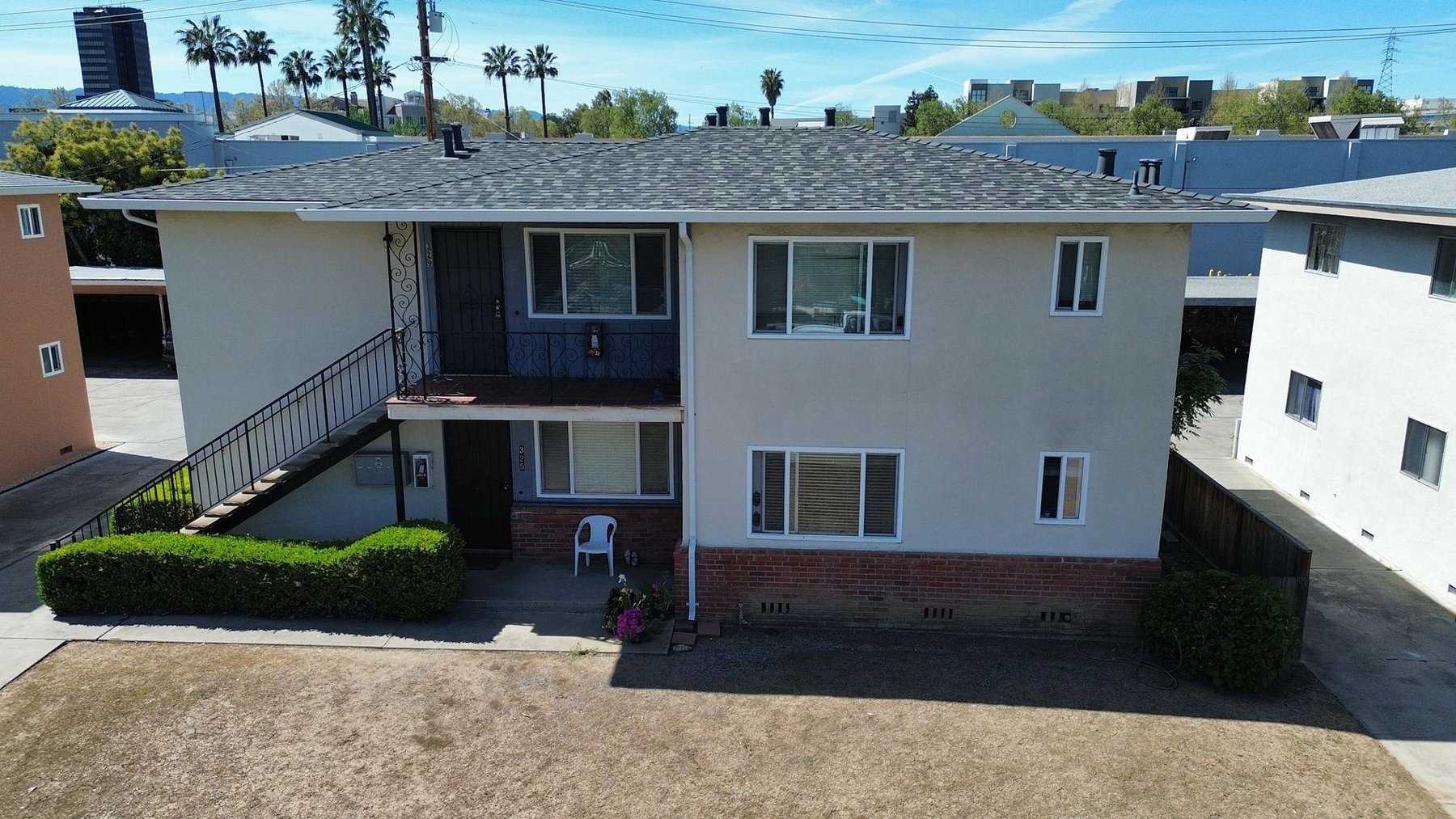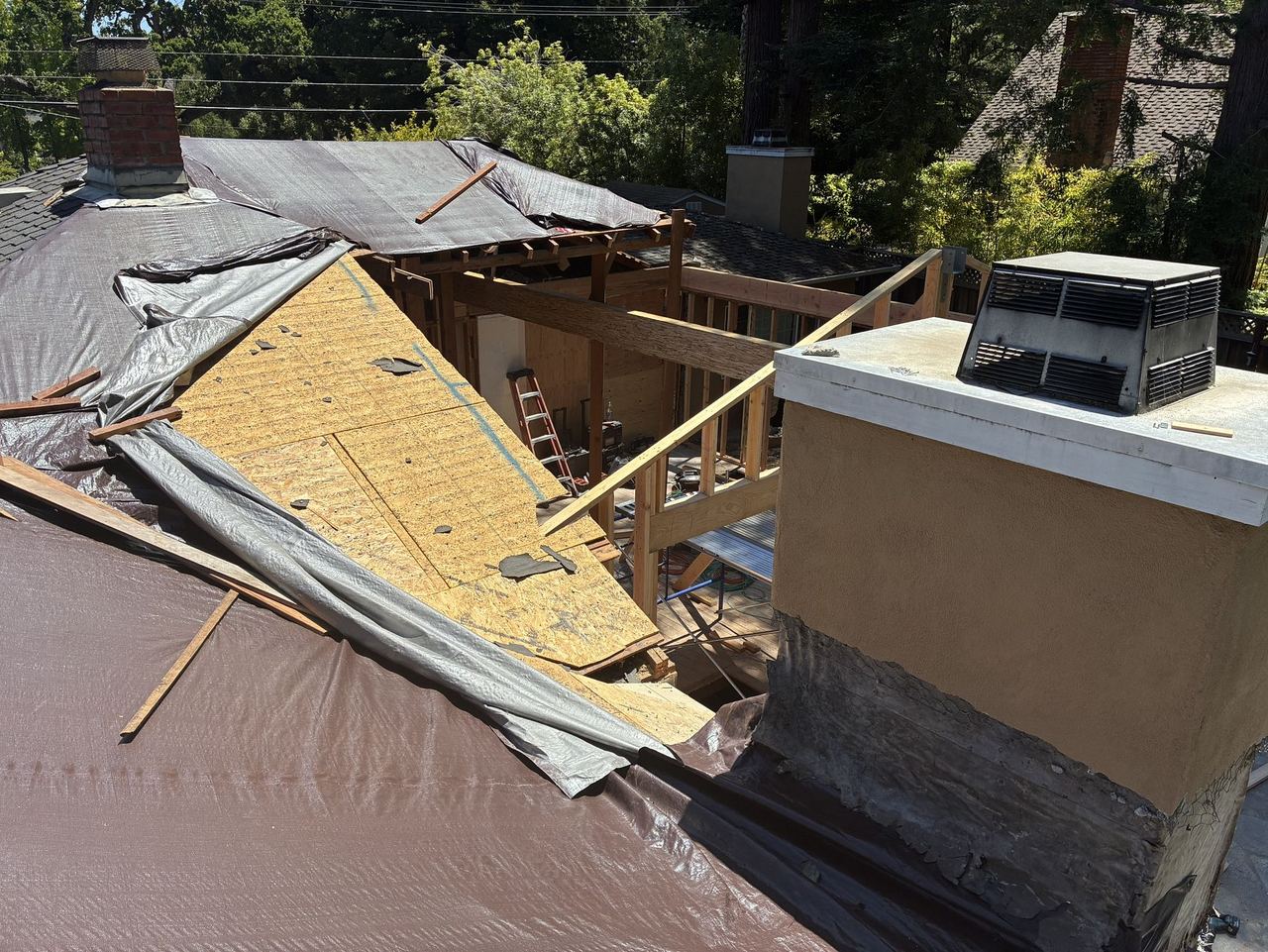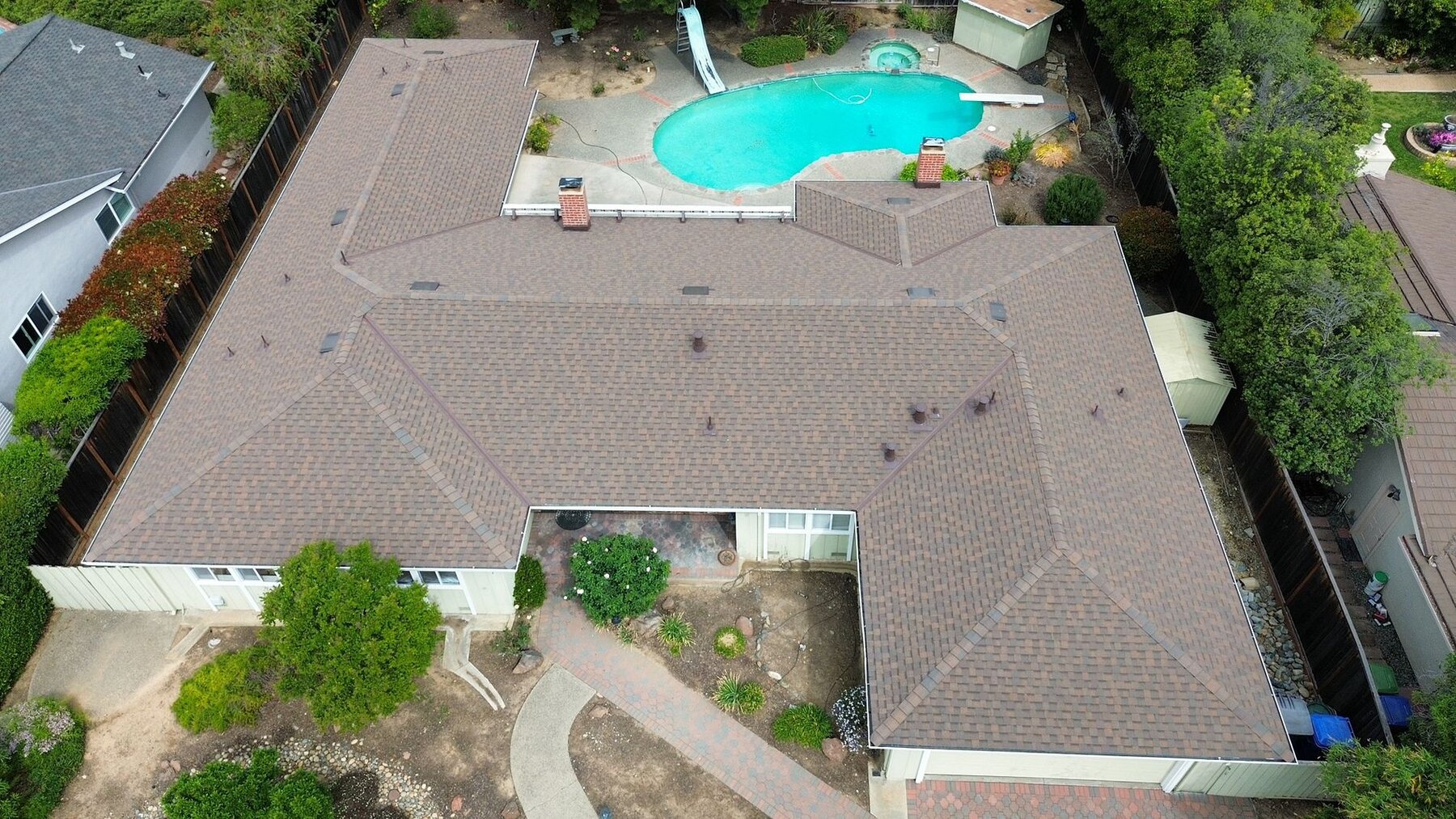
This guide covers how a chimney is supposed to be kept dry, the code requirement that many mid-century chimneys around here were built without, the leaks that look like flashing problems but aren't, and what to think about with an old unreinforced brick chimney when your roof is being replaced anyway. Two of our own projects, a Willow Glen re-roof and a downtown San Jose home on N 5th Street, are the running examples, because in both the chimney was the reason the homeowner called.
Why the Chimney Is the Usual Suspect
A roof sheds water because every layer overlaps the one below it, from the ridge down to the gutter. A chimney interrupts that. On its uphill side, water arrives against a vertical wall with nowhere to go. Along its sides, the roofing meets masonry that expands, contracts and settles differently from the wood framing around it. And the brick itself is porous, so a chimney can take on water through its own face, above the roof entirely.
Add age and the South Bay climate and it becomes predictable. Long, hot summers cook sealants and shrink old mortar joints. Galvanized steel flashing, standard on many older homes, rusts through where debris holds moisture against it. Then the first serious storm of the season arrives, often with wind behind it, and drives water into every gap at once. That is why so many chimney leaks seem to appear "suddenly" in November when they have been developing all year. Our rainy-season preparation guide lists the uphill side of the chimney among the first places to clear before the storms start.
The signs inside the house are usually close to the chimney but not always right beside it: a stain on the ceiling next to the fireplace breast, damp drywall on an upstairs wall the chimney passes behind, water dripping inside the firebox, or a musty smell in the attic near the chase. Water can travel along a rafter or the top of a ceiling joist before it drops, so a stain a few feet away can still trace back to the chimney.
The Four Pieces of Chimney Flashing
A properly flashed chimney has four distinct parts. When we inspect one, we check each of them separately, because one failed piece is enough to let water in.
Apron (front) flashing. A single piece across the downhill face of the chimney, lapping over the roofing below it. It is the simplest part and the least likely to leak, because water is running away from it.
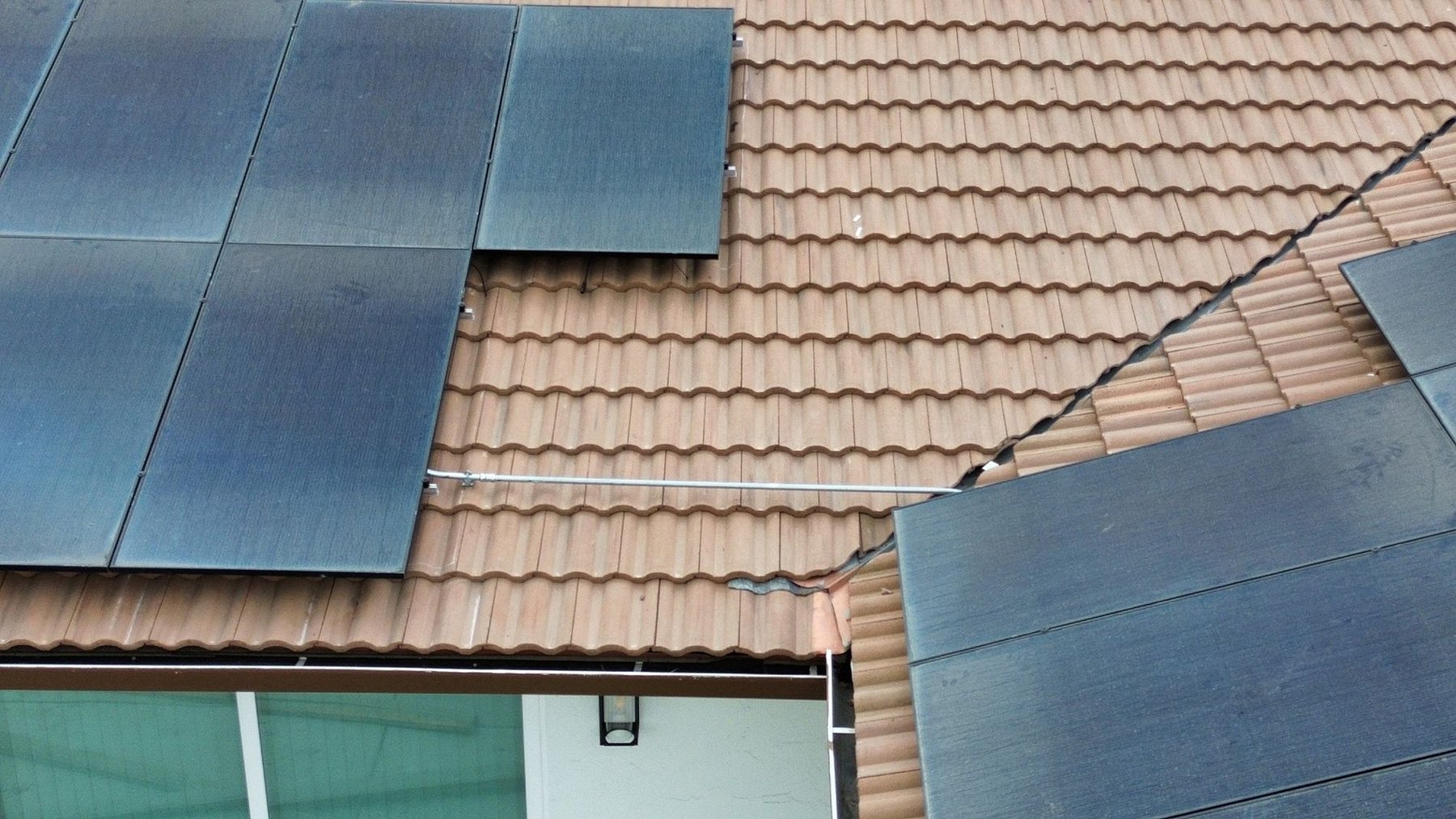
Step flashing. On each side of the chimney, individual L-shaped pieces are woven in with each course of shingle, so every piece overlaps the one below like the shingles themselves. This is what keeps water from running down the sides of the chimney into the deck. On a tile roof the side detail works differently, with a channel or pan flashing under the tile edge, but the principle is the same.
Counter-flashing. A second layer that comes down out of the masonry and laps over the top of the step flashing, so water running down the face of the brick can't get behind it. Done properly, it is set into a groove cut into a mortar joint (a reglet) and sealed there, not just glued to the face of the brick. On both the Willow Glen and N 5th Street homes, the original galvanized counter-flashing had failed, and we replaced it with copper.
Back pan or cricket. On the uphill side, a back pan of sheet metal turns water around the corners of the chimney. On a wider chimney, that job belongs to a cricket, which is the next section.
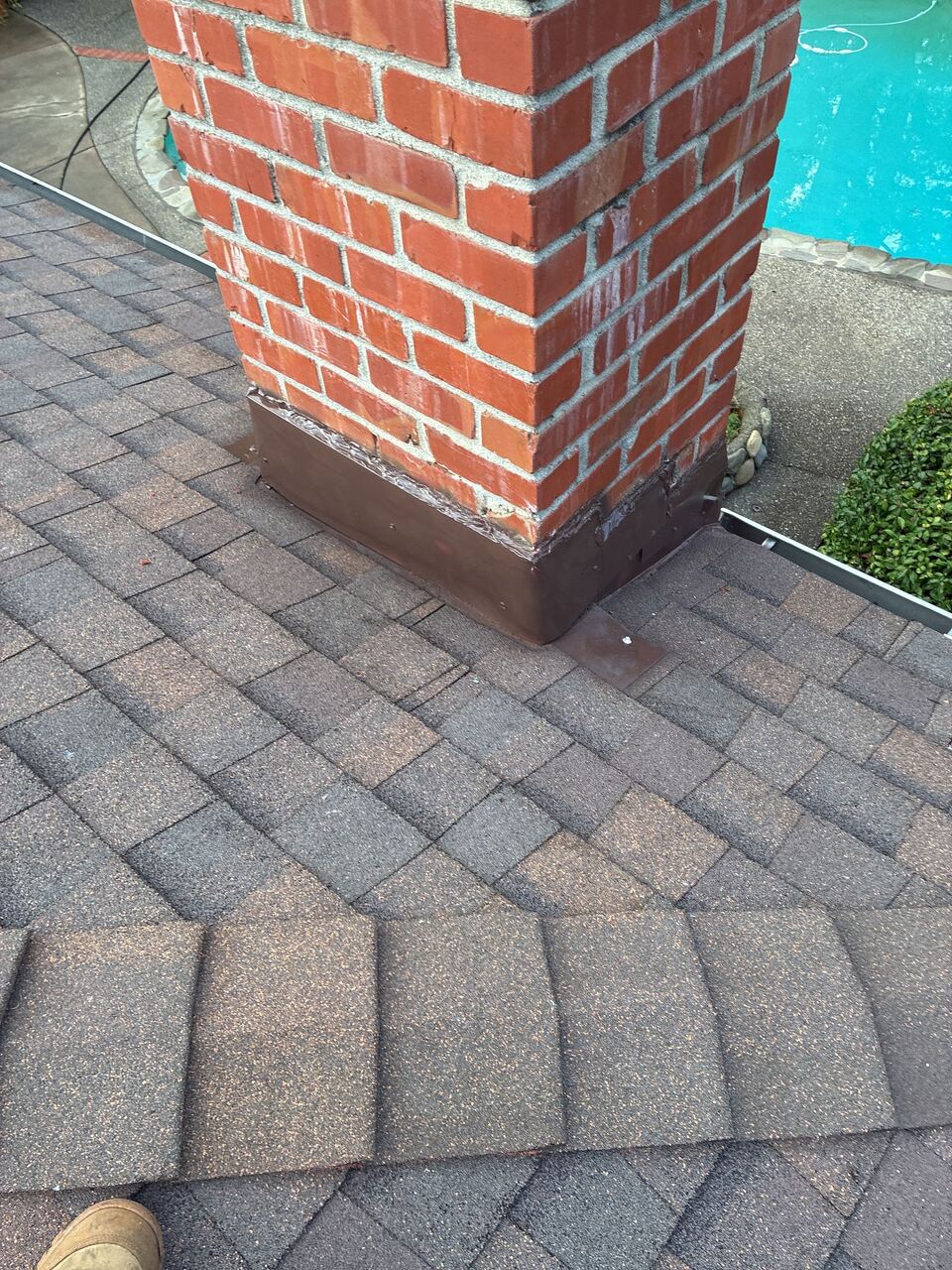
On our Saratoga re-roof, every chimney and sidewall got new step flashing woven into the shingle courses and counter-flashed into the masonry, rather than surface-applied metal held on with sealant. That is the standard to ask for on any bid that includes chimney work.
The Cricket Many Older Chimneys Are Missing
A cricket, sometimes called a saddle, is a small peaked structure built on the uphill side of a chimney. It splits the water coming down the roof and sends it around both sides, instead of letting it pool against the back of the chimney along with leaves and pine needles.
The California Residential Code requires one in a specific case: section R1003.20 calls for a cricket where the chimney's dimension parallel to the ridge is more than 30 inches, unless the chimney intersects the ridge. A chimney that sits on the ridge doesn't collect water from above, so it doesn't need one.
Plenty of San Jose chimneys, particularly on older homes in neighbourhoods like Willow Glen, the Rose Garden and central Campbell, are wide enough to need a cricket and were built without one. Without it, the uphill side holds wet leaves and debris against the brick for days after every storm, and the back pan alone eventually lets water through. When a roof is replaced, the re-roof is the natural time to build the missing cricket, framed, sheathed and flashed in metal, because the roofing around the chimney is already off.
When It Isn't the Flashing at All
Not every leak at a chimney is a roofing problem, and a good roofer should tell you when it isn't. Four common causes start above the roofline.
A cracked crown. The concrete or mortar cap on top of a brick chimney sheds water away from the flue. When it cracks, water goes straight down inside the masonry and shows up below the roof, looking exactly like a flashing leak.
A missing chimney cap. An open flue lets rain fall directly down the chimney. That water usually turns up in the firebox or the damper area rather than on the ceiling.
Porous brick and failing mortar. Old brick soaks up water, especially on the side facing the prevailing storms. Eroded mortar joints make it worse. This kind of leak tends to appear only in long, heavy rains, after the masonry has had time to saturate.
A rusted chase cover. Many South Bay homes built from the 1970s onward have a factory-built metal fireplace in a wood-framed chase clad in siding or stucco. The sheet-metal top of that chase, the chase cover, is often galvanized steel that rusts and dishes in the middle, so water ponds and eventually gets through. The fix is a new cover with a slope and a drip edge, not new roofing.
Crowns, brick and mortar are mason's work, and the flue and cap should be checked by a chimney sweep. We will tell you what we find above the roofline. If the problem is the masonry, we would rather say so than re-flash a chimney that will keep leaking anyway.
Why the Caulk Fix Keeps Coming Back
The Willow Glen homeowners called us with a leak around their original brick chimney that had been "repaired" three times in five years. Each repair added another layer of sealant over flashing that had already failed underneath. Each one held for a season or two and then let go, because sealant on a sun-baked roof dries, cracks and loses its grip on brick within a few summers.
The cost of those repairs wasn't just the repair bills. When we removed the roofing, we found and replaced about 8 square feet of rotted decking at the chimney base. On the N 5th Street house, which had two active leaks at its chimney, the figure was about 12 square feet. Water that gets past failed flashing doesn't only stain a ceiling. It sits in the wood under the shingles, and you can't see it until the roof comes off. Our guide to dry rot and the roof deck explains what that damage looks like at tear-off and how a deck repair should be documented.
Sealant has a place as a secondary seal at the reglet. It is not a substitute for flashing. If the only thing keeping your chimney dry is a bead of caulk, assume the leak will be back.
Old Brick Chimneys and Earthquakes
There is a second reason to look hard at an old chimney in this part of California, and it has nothing to do with rain. The 1989 Loma Prieta earthquake cracked and toppled brick chimneys across the region, and many older South Bay homes still have the same kind of chimney: unreinforced brick, built before modern seismic requirements.
The California Governor's Office of Emergency Services' Homeowner's Guide to Earthquake Safety warns that an unreinforced brick or stone chimney can collapse in an earthquake and fall beside the house or through the roof. It suggests a simple first check: scrape the mortar with a screwdriver, and if it crumbles, it may be too weak to withstand shaking. If you can't tell, it recommends having the chimney assessed by a licensed engineer, architect or general contractor.
Two of the retrofit options in that guide connect directly to roofing:
- Adding plywood panels on the roof framing when re-roofing, or above the ceiling joists, to protect the rooms below from falling brick.
- Removing or replacing all or part of the chimney with lighter material, for example a metal flue for the upper portion.
Both are far simpler to do while the roof is open than at any other time. Taking a chimney down, or rebuilding its top in lighter material, is structural and fireplace work that needs the right trades and normally a permit, so it should be scoped with an engineer or a qualified contractor and confirmed with the city before anyone starts. Our part is planning the roof around the decision: framing and sheathing over the opening if the chimney comes down below the roofline, or building new flashing and a cricket around whatever remains.
Fix It Now or Wait for the Re-Roof?
If your roof has plenty of life left, a chimney leak is a repair, not a reason to re-roof. Re-flashing a chimney properly means removing the roofing around it, installing new step flashing, counter-flashing and a back pan or cricket, and re-roofing that area. That is targeted work, and it is what our roof leak repair team does most weeks of the rainy season.
If your roof is near the end of its life anyway, putting new flashing into old roofing can mean paying for the same work twice. In that case, a temporary repair to get through the winter, followed by a full re-roof with all-new chimney flashing, is usually the better use of money. Our guide to how long a roof lasts in San Jose can help you place your roof on that timeline.
Either way, three questions are worth asking whoever bids the work:
Will the counter-flashing be set into a reglet in the mortar, or attached to the face of the brick with sealant?
Does the chimney need a cricket, and if it's more than 30 inches wide and not on the ridge, is one included?
What happens if the deck at the chimney base is rotten? A careful roofer expects it on a chimney with a leak history and will tell you up front how it will be documented and priced. Our guide to hiring a roofer in San Jose covers what a fair change order looks like.
If water is coming in right now, our guide to handling an active roof leak covers the first hour and the first day. When you're ready for someone to look at the chimney itself, a roof inspection checks every piece of flashing, the cricket or back pan, and the deck beneath, and tells you whether the problem is roofing, masonry or both. Keith Roofing Company has worked on San Jose roofs since 1952. Schedule a free estimate or call (408) 295-8616.
Frequently Asked Questions
Need professional help with your roof? Keith Roofing Company has been serving San Jose and the South Bay since 1952. We offer free estimates, honest recommendations, and work that's backed by BBB A+ Accreditation and CSLB License #1118418. Schedule a free estimate or call (408) 295-8616.